This is a third part in a series of posts dedicated to Battlepacks. Today we focus on Tidal Pack (available through Battlepacks tab on top of the page or this link), but if you missed previous ones about Core Book and Rumble Pack you can find it here: part I: Core Book, part II: Rumble Pack
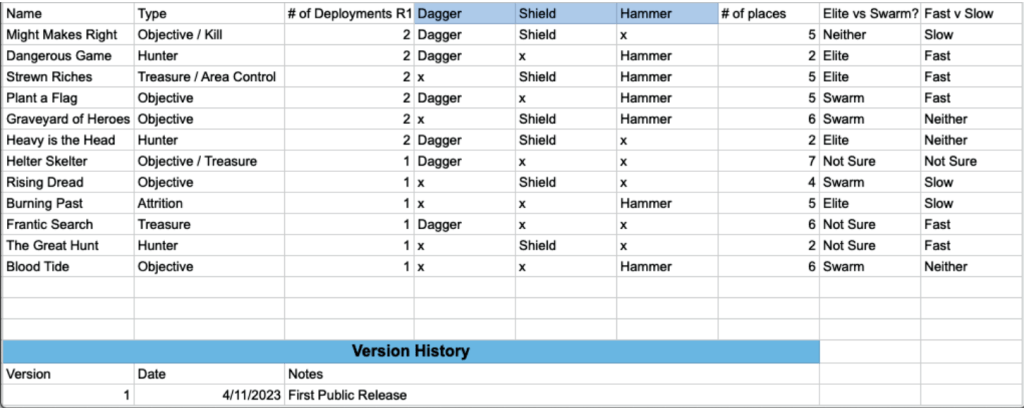
First version of Tidal Pack (at the time of writing this its the only version) was released in April 2023 and contains 12 battleplans. Unlike Rumble Pack described in previous article Tidal Pack does not contain any information about author idea of running the pack (no tiebreakers, no information about the time of games, minor/major victories and even if battleplans are supposed to be decided randomly or “preselected”). The only information outside of battleplans is the table below:
If anyone is interested with the author intention and some of ideas behind it then the author himself created a youtube video (as always – I strongly recommend theSaltySea youtube channel) about it:
Battleplans
Let’s start with analysis of all 12 scenarios and go to bigger picture at the end.

This is the only battleplan written in a style of Victory cards, where players make decisions about location of 4 out of 5 objectives. The 6″ minimal distance between objectives make it possible to set up objectives in the way that a fighter can contest two or more objectives at the same time, which may lead to interesting situations (Ironjawz Brute sitting on 3 objectives can influence all 3 with You messin’).

If you want to position “your objectives” defensively, as far from the opponent as possible then if you are mostly scarred of enemy Dagger you can end up with one objective in the corner between your Shield and Dagger (keeping the 4″ distance from battlefield edges) and second objective as close to it as possible next to longer battlefield edge. This way the distance between opposing Dagger and objectives you set up is 15,81″ and 18,6″, which is quite significant and most fighters will need 2 turns to get there (remember that you can deploy 3″ away from deployment point and start contesting objective from 3″ away, so to measure minimal travel distance you should substract 6 from distance). If you are afraid of enemy Shield you can set up second objective next to shorter battlefield edge, so the distance between “your” objectives and deployment point of enemy Shield is 20,02″ and 21,19″ which (with some terrain on the way or some clever bodyblocking) should require 3 turns of movement. This mean that with defensive setup you will mostly have to worry about enemy Hammer flanking you, but it should be heavily outnumbered with your Dagger and Shield deploying one turn earlier in the area.
The secondary scoring is very well balanced here and for “killy” and durable warbands simply controlling 2 defensively positioned objectives and hunting enemy Hammer and some easier to kill fighters around middle objective should be quite effective path to victory.
Despite the You messin’ problem I think its a great battleplan. The fact that scoring rewards killing as much as objectives means that easy to kill chaff becomes a liability against opponents with good power projection. Ability to place objectives opens a lot of strategies and gives possibility to decrease or increase the distance between objectives depending on which player is expected to have advantage in getting “kill points”.

This victory condition is copied from Victory cards from one of these season “big boxes” with 2 warbands and terrain (spooky trees). I have one big problem with this battleplan and it’s the wording GW used here. It uses the term “start of battle round” as the moment when player’s make decisions and the player with Initiative makes his decision first, which means that Initiative phase must be BEFORE start of battle round, but Core Book says that Initiative phase is part of the battle round (so there is no player with Initiative before first battle round).
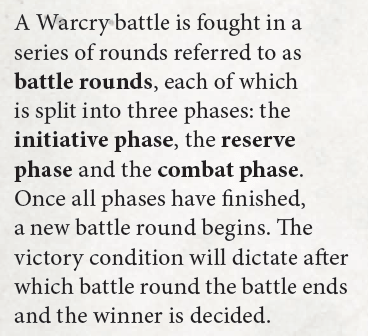
This is FAQ material, but until clarified by GW I (and our local TOs) read this instance of “start of battle round” as “as early as possible after initiative is decided”, which mean that for the first two rounds you are picking hunted fighter before reserve phase, so first two hunted fighter’s can’t be picked from opposing Shield. It also makes freshly deployed fighters immune to death from staying within 4″ of battlefield edge after being netted in their first turn. I can’t blame the author for copying GW wording here, but fixing this wording would be a great “addition” to this mission (I’m sure a lot of people are playing it differently to what I described above – we run this mission in one of our tournaments and a lot of players were confused and misinterpreted this wording). Outside of my problem with wording I actually really like this battleplan. The deployment map chosen for this Victory condition works great. Great choice of “kill mission” and I agree with the author that it favors fast and elite warbands.
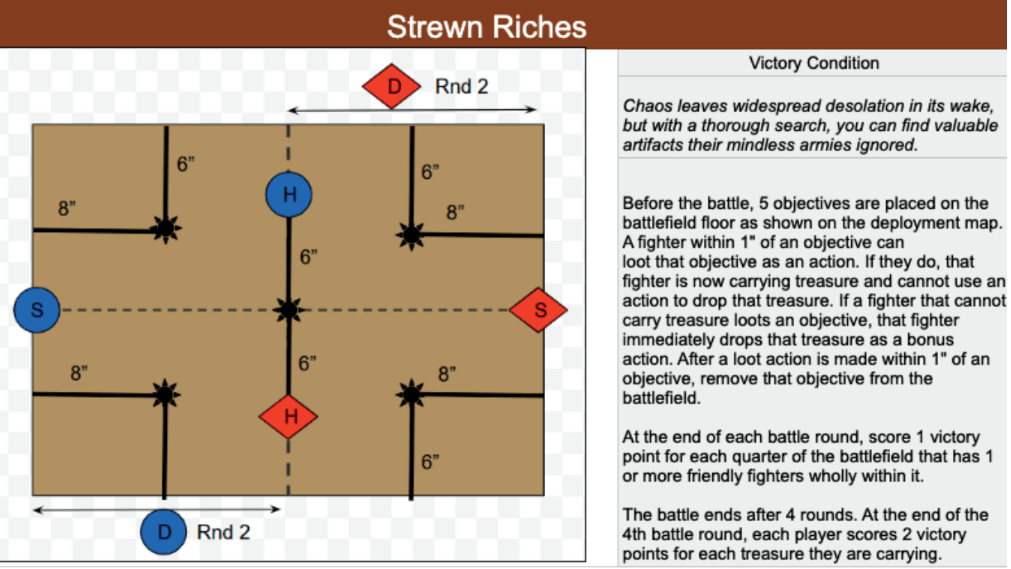
I believe that author should spend a bit more time on this battleplan. It’s a combination of modified Loot and Pillage from Rumble Pack with Conquering the land sidequest (points for quarters). I think the effectiveness of secondary scoring mechanic used here is strictly connected with it’s opportunity cost. Here it seams that the opportunity cost is supposed to be the limitation of which treasure the fighter designated to “scoring this quarter” will fight for. The problem is that with treasure in every quarter of the map there is not much you lose (if anything) for staying in battlefield quarter for points in early rounds and in later rounds players tend to move their treasures into the part of the map where they are strongest, so you have a part of the map where you want to be to protect your treasures and part of the map where enemy treasures are, so again basically most of the map is where you want to be. I would say that Original Loot and Pillage worked better with Conquering the land because 4 out of 6 treasures were in battlefield corners and very close proximity to enemies resulted in them staying there longer. 2 quarters without treasures in corners required “sacrificing” fighters for points or using fighters around middle treasures, which were in range of enemies that could take them down preventing points from secondary scoring. As treasures can be moved constantly changing the opportunity cost of Conquering the land I think its a bit better suited for objective mission where the opportunity cost could come from the places where you can contest 2 objectives at the same time lying directly between quarters of battlefield so in order to contest 2 objectives at once you have a fighter that is not wholly within any quarter of the battlefield. Other solution would be to (similarly to Loot and Pillage) move treasures out of 2 quarters of the battlefield. Outside of “misused” potential of Conquering the land I think that balance between primary and secondary scoring is a bit off with all treasures granting maximum of 10 points and scoring quarters granting maximum of 16 points.
Despite all of my complaints I think the battleplan is fine and all it needs to be very good is some small tweaks (mostly in position of treasures), as currently I think it’s a “sidegrade” rather than an upgrade of Loot and Pillage + Conquering the land. I already compared this battleplan to Loot and Pillage a lot, but last “advantage” of “original” from Rumble Pack was that it wasn’t possible to use Sylvaneth teleporting trees to move to non-middle objective first round, loot it and teleport away (additionally when teleporting to treasure first round and moving towards your forces it wasn’t possible to move in a way that forces deployed second round would body block access to treasure bearer).

Here it’s only possible for fighters from Hammer (3 treasures are in range of such play) and the fact thet there is only single treasure coming out from every objective makes it way stronger than usually.
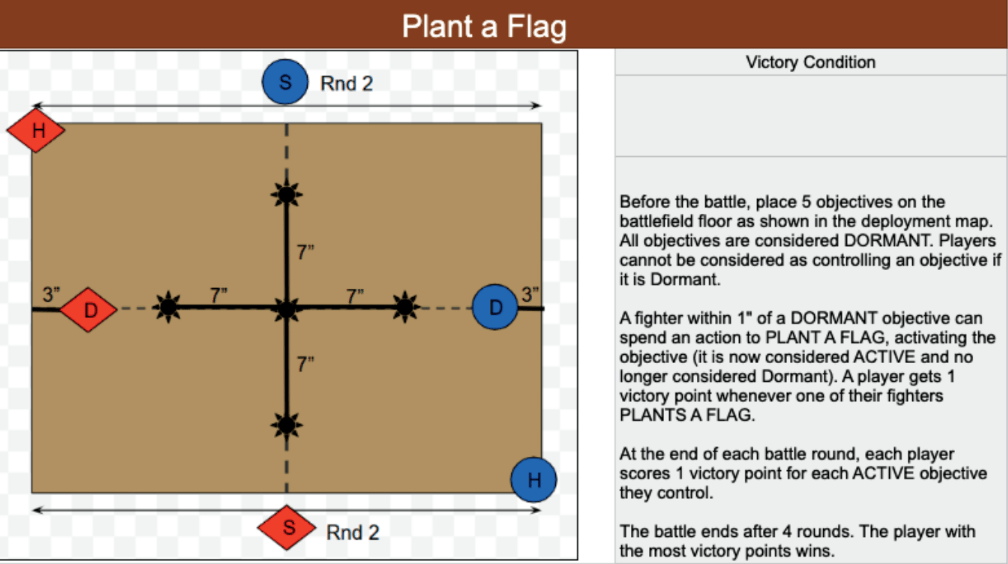
I’m not a fan of “corner deployment” for few reasons but here at least the distance to enemy forces is enormous so “alpha blocking” could never happen, which I believe is good. The fact that you need to spend an action while within 1″ of objective to score additional points changes early game to a race. The distance to objectives is huge (5″; 12″; 13,89″; 13,89″; 19″ for Dagger and 13,6″; 15,52″; 18,6″; 23,43″; 24,6″ for Hammer) and requires a fighter from Dagger to traverse 8″ or 9,89″ to get into “flag planting reach” of middle objectives. I like the idea behind it, but the 3″ move abusers that I think were targeted by this battleplan (or at least most of them) won’t have a lot of problems planting the flag on middle objectives in first round of the game. The warband to beat – Nurgle Chimera will sent Chimera and plant a flag (thankfully it has a base few milimiters too short to plant 2 flags), SBGL horde can reach middle objective with Dire Wolf or 5+ Shambling Horde, KO has baloons, OBR also has access to Dire Wolves and even CoS dwarfs can use Swift as the Wind (Tempest Eye triple) + Outriders of the Realms (Tempest Eye double) to reach any of the middle objectives with 3+ triple and double. Because of all this I think that instead of intended situation where slow warbands are being punished we have a problem that early lead from planting more flags than your opponent is more connected with winning initiative than actually having speed advantage.
The other key aspect of Plant a Flag battleplan is that there are 4 spots where fighters with 32mm+ base can contest 2 objectives at the same time, which can be very valuable for elite warbands, but is also punishing warbands with small bases (RIP DoK). It’s also a second battleplan where you can use You messin’ on more than one objective. I don’t agree with author suggesting that this battleplan favors fast warbands as winning the “flag race” for early advantage is more connected with warband abilities than their speed (5″ and 6″ base move warbands like for example Skaven without Deathmaster can have problems planting the middle flag first turn, while full 3″ move skeleton spam can get there easily).
In the end I like the idea behind this mission and creative approach, but I fear that it is not reaching it’s intended goal as well as it could (outside of Hammer most objectives are easily reachable 2nd round by 3″ move fighters and the fast warbands early advantage come mostly from deployment map and way less from the flag planting thing) and I don’t like the initiative roll impact on scoring in first two rounds. It’s a good battleplan, but with some tweaks it could be great.

This mission is Supremacy with modified an early grave sidequest from Rumble Pack and new deployment map. I’m not sure why anyone would want to “deincentivize” usage of thralls, especially when for some factions they are the best (and sometimes only) option for cheap fighters (Nurgle mortals, Jade Obelisk or arguably Nighthaunt), so I believe it should target only allies and heroes (listing ‘leader’ next to ‘hero’ seams to be a mistake that wasn’t spotted before publication) and the ally part is also not something I agree with, but something I can understand.
Distances here seam significant, but 4″ move fighter from Shield (or 3″ move fighter that uses Rush) can reach the 5th and 6th most distant objectives (13,93″ between objective and deployment point) without using any abilities in 1st round (assuming perfect positioning and no terrain on the way), which together with scoring every round and possibility to score up to 6 points per turn from objectives alone makes it a perfect mission for horde warbands, but the secondary scoring mechanic adds a way to close the gap for horde players. I think adding more potential targets for this particular secondary scoring mechanic is a great decision (even if I don’t agree with thrall hate) that changes the dynamic of heavy objective mission into the direction of kill mission.
This mission has similar problem to the one I described in Plant a Flag – only 32mm+ base fighters can contest two objectives at once (4 spots that let you do that), which isn’t something I’m a fan of.
Overall the mission is good. I’m not sure about the balance between primary and secondary scoring (it’s difficult to evaluate, so I will assume it works) and don’t like the anti thralls approach, but overall I think this mission “upgrades” an early grave in an inteligent way, so I think in general it’s an improvement from Supremacy + an early grave pair from Rumble Pack.

It’s simply Reaper with a Forsaken Gimmick. I really dislike Reaper and adding Forsaken mechanic is not fixing it in my opinion. This variant certainly lead to bloody and tense battles which for some crowds is great, but its a pass from me. I didn’t expected this battlepack to have missions I would dislike, but from what I can see it’s trying to be an evolution of both Core Book and Rumble Pack stitched together and in this case it could not skip Reaper as it is a classic at this point and a lot of people really enjoy this mission. This is why I’m not surprised this mission is here and I agree with the reason why its here, but sadly I’m the wrong kind of player for it.

After playing some Objective missions from Rumble Pack with a sidequest adding treasures I must say I’m not a fan of this king of battleplans. The Fact that you have 7 important areas of the map with only one battlegroup starting in first round seam to favor hordes. I think the idea behind it was that elites (in the matchup against hordes) can be more “efficient” and use treasure bearers on objectives while hordes would want to run away with treasures losing numbers on objectives. Deployment map seam to be perfectly picked for this mission as there is no place you can go with treasure to thin your less numerous opponent numbers on objectives as fighters from Dagger after catching treasures can only go towards objectives or enemy forces. I don’t think my description is clear, so I will summarize it this way – it’s the best approach of merging treasures and objectives I’ve seen. I like it and I’m impressed how well deployment map supplements the victory condition. I think the 4″ rule doesn’t have to be there as the description is already quite long, but outside of this I feel this is a very well designed mission. I totally get the “no sure” entries in “summary table”, but with 4″ take down rule I think it favors slow warbands a bit.
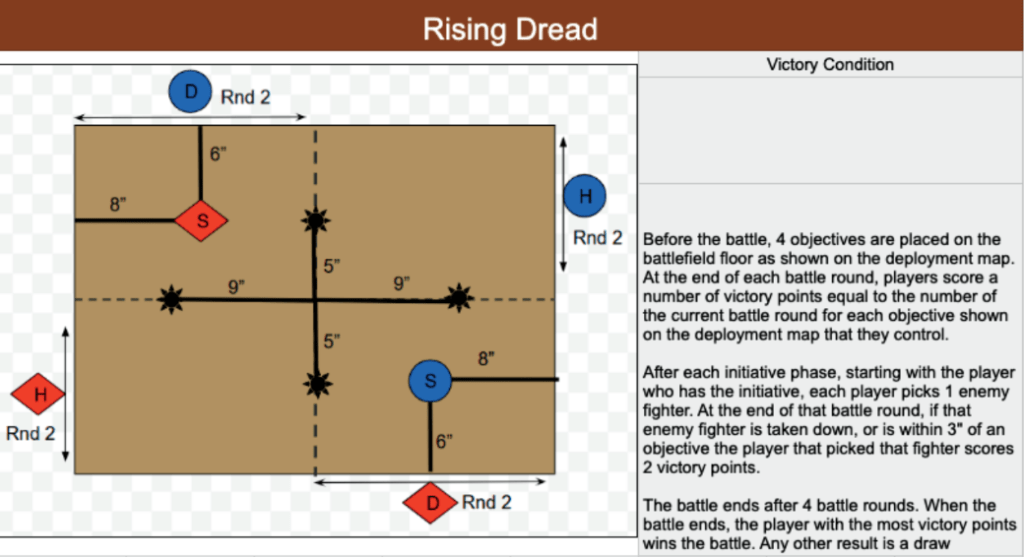
It’s a Seize and Control from Rumble Pack with deployment map changed to slightly increase distance between objectives and removed 10 points rule with Predator and Prey sidequest. The average distance to objectives for all deployment groups and Shield alone is in both cases less than 1″ bigger than in Rumble Pack counterpart, but keeping 3rd and 4th objective more distant from starting point of first round deployment group would give small advantage to faster warbands only if opponent would have similarly long path. Currently that is not the case so I totally agree with author that it favors slow swarms. The changed deployment map is not adding anything new so in my opinion it’s another “sidegrade” from Rumble Pack mission+sidequest pair. I wonder if there is anything impactful I can’t see in the change to distance between objectives. I don’t like using this sidequest with only one deployment group starting the game as in first two turns only fighters from Shield can be chosen for Predator and Prey (Initiative phase is before Reserve phase).

It looks like Hidden Vault from Cor Book with 2 extra objectives and 1 extra round of scoring. I don’t understand why extra scoring turn was introduced here as added objectives already improve on original mission so much. There is value in simplicity and every rule has its cost, here I don’t understand what was “bought” with scoring in 2 rounds. Original Hidden Vault mechanic resulted with players fighting over central objective in 90%+ of games (I have no data to support this – it’s based on my experiences and some opinions I found online) and here the removed objectives can differ based on composition of both warbands. I’m not a fan of later rounds deployment from single point and already mentioned 3rd round scoring, so there are ways of making in better (at least for me), but overall I think its very solid mission that fixed Hidden Vault problems, so I see it as clear improvement on original.
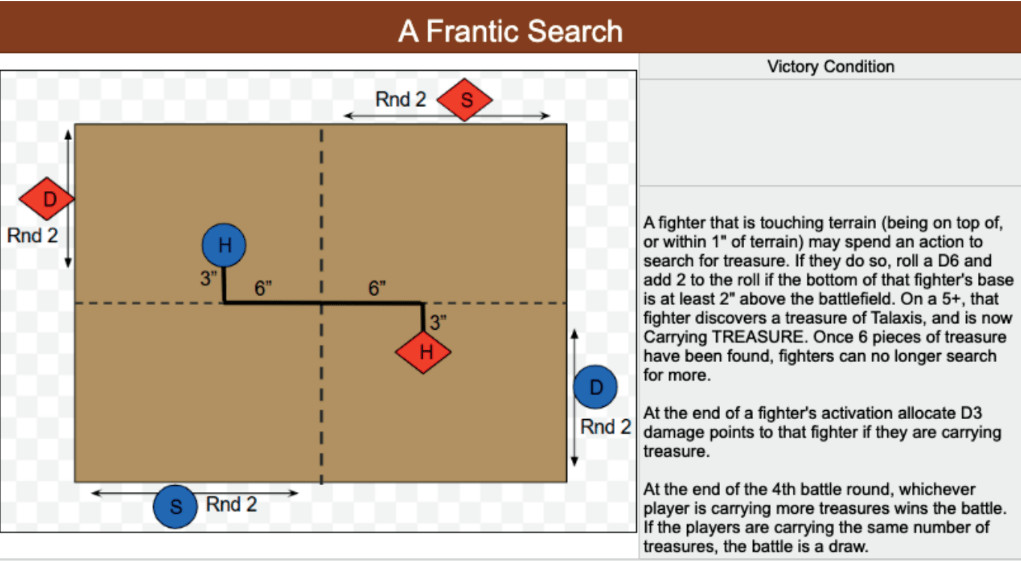
The reason I hate missions that grant players advantage based on initiative roll is that in my opinion result of the game should come mostly from players skill. Differences in factions strengths and weaknesses are enough to usually have one player having advantage from the start. Adding advantage based on dice roll to one of the players will either diminish the “David defeating Goliath” feeling as part of success against stronger opponent came from random (and therefore not “earned”) advantage and in case where stronger player gets the advantage it often lead to NPE.
This battleplan is a great example of the problem I just described. You can do everything right and lose the game because of dice rolls that where not connected with interacting with opponent, but interacting with scenario. If you roll poorly when attacking someone then not only your situation in game is getting worse – your opponent situation is getting better, so someone is feeling good as a result and having fun together is one of the main reasons we play the game. In this mission when you or in worst case both players roll poorly on extracting the treasures then there is nothing positive coming from bad dice rolls as it sucks for both players. This is why I’m not a fan of having random mechanics that influence game aspects directly connected with scoring and also that is why I don’t like this mission. It would work great in more “narrative” environment where randomness and higher interaction with the battlefield work way better but in classic “contest of generals” it is a pass for me.
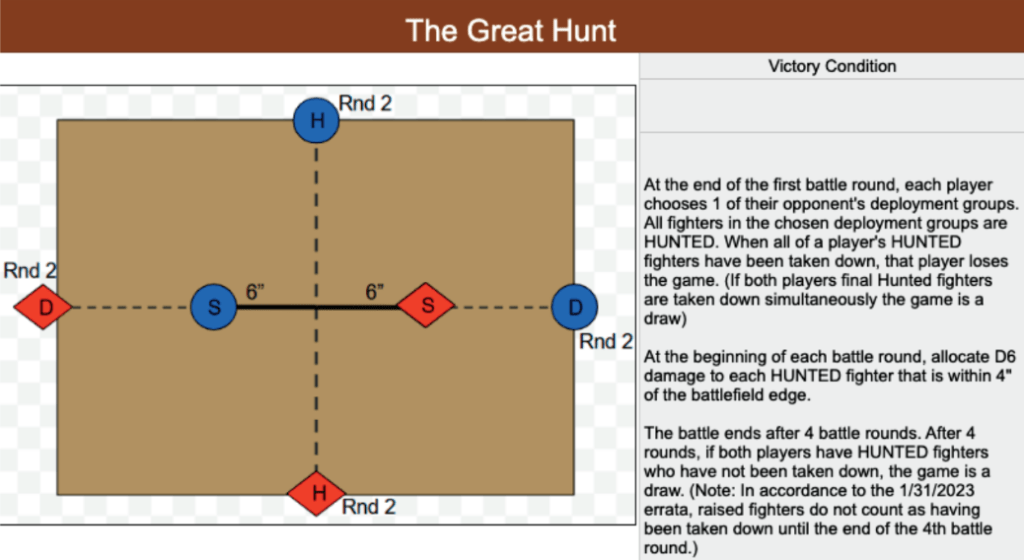
Killing entire battlegroup is a first edition classic and I like the idea, but I think deployment map could be improved a bit, as in situations where you know the tournament battleplans ahead of time you can prepare to “alpha block” enemy Dagger with your Shield and you can optimize a lot for this kind of situations. I think this kind of mission also works better with more deployment groups starting in round one especially with the 4″ rule that actually takes away over 50% of the map for Hunted fighters. Solid mission that has some potential for improvement (I would never want to play it against Horns of Hashut, so maybe there needs to be some “anti Engulfing Flames” modification).
EDIT: Next Norcry tournament will be using modified version of this battleplan with deployment areas changed from single point to whole length of short and long battlefield edges. While it fixes the problem with Engulfing Flame power it also makes it a bad idea to pick battlegroup that is deployed from long battlefield edge. I think it also makes initiative roll in second turn extremely impactful. I believe Norcry TO (best wishes Krister) went a bit too far with his changes and half of battlefield edge for second round deployments would be a better choice and this is what I suggest for next iteration of battlepack

Its Tides of Battle from Rumble Pack with Core Book’s Reaper added as secondary scoring. Even deployment map is almost exactly the same as in Tides of Battle. I have no idea why 1VP/round secondary scoring from Reaper is added to 7VP/round that can be gained from objectives as it is always better to focus on objectives. I would even say that prioritizing wild dice usage on losing the initiative (“creating” doubles is always lowering your initiative and if singles difference is too big to lose initiative this way, storing them for next rounds to do it again) has way bigger impact on scoring than actually killing your opponent fighters as usually you can guarantee control over one of objectives. Additionally it’s another instance of initiative based advantage that unlike treasure/kill missions doesn’t have to exist in objective mission and therefore (if possible) should be eliminated.
One of the reasons some people hate Rumble Pack is that secondary scoring from sidequests is not giving enough Victory Points to counterbalance dominance of horde warbands. This battleplan is an extreme example of this and I simply don’t understand why Reaper is added here. For me it’s clear downgrade from Tides of Battle as most Rumble Pack sidequests will give more meaningful and valuable secondary VP sources to go for. Additionally the changes to deployment map are not changing the distance to objectives in significant enough way: In both cases fighters deployed in first round can get to 3 closest objectives without problems with move characteristic of 3″ and the average distance to objective for fighters deployed in first round increased by only 0,2″. The average distance to objectives for all deployment groups decreased from 16,37″ to 13,6″. The only “visible” change is that 3″ move fighters lack 0,04″ to get to forth closest objective, so they need to use movement related ability to do it, which for me is no change at all, so the changes seam to be targeted at improving the “Reaper experience” and as I explained above – it’s a tiebreaker at best (VP wise).
Battlepack summary
This post is already super long, so let’s summarize a bit. I counted 3 original battleplans (Frantic Search is probably based on older Victory cards, but as I don’t remember the exact card, then let’s treat it as new idea) and both Might Makes Right and Plant a Flag are good, but I don’t like A Frantic Search very much because of how random it is (I get that it’s “different” kind of treasure mission, but if you want to have more distinctive treasure missions then you can just change it to 4 rounds of scoring or add points for making opponents drop treasures or any other non random idea). There is also The Most Dangerous Game, which is a “reprint” of less popular GW battleplan that I already like a lot so I think including it is a success and the Great Hunt that is a reprint of “classic” kill mission, that I also like. Out of remaining 7 missions 2 of them are modified versions of Core Book: Burning Past is aa greatly improved Hidden Vault and Heavy is the Head is a bit better Reaper (a bit “less bad” is a bit more accurate here). Almost half of this battlepack (5 missions) is modified battleplan + sidequest pairs from Rumble Pack: Strewn Riches is Loot and Pillage + Conquering the land and I belive that original combination is better, Graveyard of Heroes is Supremacy + An Early grave and I believe theSaltySea version of this sidequest is better (I simply don’t agree with “thrall hate”), Helter Skelter is modified Seize and Control + Stolen Wares and both original Seize and Control and the Tidal Pack version are great, Rising Dread is Seize and Control + Predator and Prey and it’s basically the same, Blood Tide is Tides of Battle + Reaper (not a sidequest here, just Core book battleplan as secondary scoring) and I think it’s a downgrade to both Tides of Battle and Reaper. Overall I think there are 5 great missions, 4 good missions and 3 bad missions (somehow Reaper that I dislike with passion appeared here twice), lets fly a big higher to see the bigger picture next.
Let’s start with Horde vs Elite topic that dominated most Rumble Pack related discussions – Overall more numerous warbands should do good here as according to “#of places” part of summary table in 75% of all battleplans there is 5 or more “places to be” on the map. Also half of the missions you have only one deployment group on the map in first round which combined with scoring happening every round in most cases is also a good news for horde players. However the treasure/kill/objective balance is greatly different from Rumble Pack and mostly because of it hordes will definitely be way less favored than in Rumble Pack (elites often do better in kill and treasure missions). So in comparison to 2 previously analyzed battlepacks it is less elite friendly than Core Book and less horde friendly than Rumble Pack, which is exactly where it wants to be.
As far as “slow vs fast” is concerned, it’s very difficult to analyze, but from mission like Plant a Flag we can see that author wanted to give a small advantage to faster warbands (which I support totally), but I’m not sure if the end result is as friendly to faster warbands as originally intended.
The aspect I have the most trouble with is the unjustified (in my opinion) treatment of thralls and 25mm base fighters. This battlepack gives incentives to not bring them and as far as smaller bases are concerned this could be unintended consequence (that still should be removed in future versions if you ask me) of objective placements, but for thralls its a direct rule that is hurting lists from outside of “top tier of competitive netlists” (at least for destruction and chaos).
My next complaint is for lack of flavor text in part of the missions and there is simply no excuse for that. This and the fact that there are both missions with one and two deployment groups starting the game in first round and that there is single mission where players decide on objective placement make it feel like a way less “completed” (I’m not sure that’s the right word here) project than it actually is and a bit more like random compilation of battleplans (which I know it isn’t). I would like to see more “unification” here as I also disagree with the notion that merging both approaches is the only way of balancing deployment groups in a 4 round tournament.
If you managed to get this far I hope some heavy mathammer won’t scare you now dear reader, so let’s dive in on some numbers. I already mentioned that there were some attempts at increasing the distance to objectives (Plant a Flag) to decrease the power of 3″ move fighters, so let’s see at average distances to objectives and compare it to Rumble Pack:
| Measurement | Tidal Pack | Rumble Pack |
| Average Distance to Objectives for Dagger when deployed first round | 12,29 | 12,79 |
| Average Distance to Objectives for Dagger when deployed second round | 13,00 | 13,80 |
| Average Distance to Objectives for Dagger | 12,70 | 13,30 |
| Average Distance to Objectives for Hammer when deployed first round | 12,90 | 7,70 |
| Average Distance to Objectives for Hammer when deployed second round | 13,43 | 15,05 |
| Average Distance to Objectives for Hammer | 13,10 | 13,83 |
| Average Distance to Objectives for Shield when deployed first round | 12,37 | 11,19 |
| Average Distance to Objectives for Shield when deployed second round | 14,92 | 16,82 |
| Average Distance to Objectives for Shield | 13,80 | 14,94 |
| Average Distance to the closest Objective when deployed first round | 6,80 | 6,49 |
| Average Distance to the closest Objective when deployed second round | 6,59 | 6,94 |
| Average Distance to the closest Objective | 6,68 | 6,79 |
| Average Distance to 2nd closest Objective when deployed first round | 9,38 | 8,44 |
| Average Distance to 2nd closest Objective when deployed second round | 11,11 | 11,71 |
| Average Distance to 2nd closest Objective | 10,34 | 10,62 |
| Average Distance to 3rd closest Objective when deployed first round | 13,15 | 11,68 |
| Average Distance to 3rd closest Objective when deployed second round | 13,92 | 15,17 |
| Average Distance to 3rd closest Objective | 13,58 | 14,01 |
| Average Distance to 4th closest Objective when deployed first round | 12,97 | 13,47 |
| Average Distance to 4th closest Objective when deployed second round | 17,25 | 19,51 |
| Average Distance to 4th closest Objective | 15,82 | 17,50 |
| Average Distance to all Objectives when deployed first round | 12,57 | 11,41 |
| Average Distance to all Objectives when deployed second round | 13,81 | 15,33 |
| Average Distance to all Objectives | 13,20 | 14,02 |
As you can see from all of the numbers above Tidal Pack is very close to Rumble Pack when average distance values are concerned. The only big difference is that there is no Spoils of War situation with Hammer starting basically on top of 2 objectives. I left Core Book out of this comparison as the only truly comparable mission would be Laylines. I can also see that (most probably intentionally) 3rd closest objective for fighters that are deployed 1st round is a bit more distant now and will more often require 3″ move fighters to use abilities (also 4th closest is closer in Tidel Pack), but as the changes in distance values aren’t that high it is more connected with single battleplans than a big trend implemented in all of them.
I left one of the most important topics for the end – internal deployment group balance. Core Book was awful with it with Dagger being way more important than other deployment groups (I don’t want to repeat myself so more on that in part one of the series). Rumble Pack was a bit better but Hammer had a bit higher priority due to possibility of burning objectives that were conquered first round. Tidal Pack is difficult to evaluate because its a mix of missions that start with one and two deployment groups in first round. I believe that deployment group balance across all battleplans is impressively well done with Hammer being a bit less important than 2 other deployment groups, but I only based that on deployment map analysis and relation between when they enter the battlefield and when the scoring is happening.
Overall I think that Tidal Pack is good and is an improvement on both Core Book and Rumble Pack but I believe that there are few single changes that can elevate it to “great”. I have few more opinions but as its already the longest post on this blog (and writing it took weeks) I think they can wait for review of Tidal Pack 2.0.
Also congratulations to Dan (Tidal pack author) as his baby was recently born
I hope next post in the series will show my own attempt at writing battlepack (it’s almost done and only deployment maps need some balancing), so when it will be published the link to Mark of Chaos battlepack will appear -> here.
 Overthinking Warcry