Nova Open Warcry tournament just happened and it was full of interesting ideas and innovations. In this article I will completely skip battleplan selection, list review and the tournament meta, as in my opinion the biggest innovation was definitely the tournament format. I want to start by saying the purpose of this is not to make anyone feel down, that’s why I removed all the player names from the graphics I use. I also don’t want to say that it was a bad tournament as the winner definitely deserves his trophy and I only heard positive things about it. I want to analyse the results of very innovative approach and indicate that for some of the goals there are alternate paths that depending on our priorities may be better or worse. Discussing the format requires analysis of 2 topics that were changed the most: Tournament structure and Scoring. Before going further with the topic I will let the author himself to explain some of the reasons for the changes made (heavily recommend Winning Warcry segment of Tabletop and Beyond podcast, relevant part starts at 1:14:00, but the whole episode is great):
Tournament structure
The TO intention was to run the 32 player tournament in 2 stages: 3 rounds with 4 pools of 8 players and then 2 rounds with 8 pools of 4 players with the intention that firs stage is a qualifier to second stage where players that finished 1st stage on certain position will the play a 2nd stage (mini tournament) only against players that placed the same in other pools. Because of the fact that not all players showed up and some left during tournament the final format was a bit different: 4 pools of 6/6/6/8 players followed by 6 pools of players that finished 1st round 1st/2nd/3rd/4th/5th/6th+. I will quote some of the ideas that author expressed in a video linked above: “It allows players that are on the same competitive level to find each other faster”, “It ends up giving you the solid ranking. The final table that you play will be your first and second place guys, rather than in a swiss style pairings the final table that plays the winner will be the winner, but the guy who loses may drop to like 3rd or 4th place, because of how the points work out and thing like that”, “I want a clear cut 1 to 32”. Let’s compare the quoted goals with the tournament structure. Regarding finding players at similar level standard swiss system is better as it is pairing players with similar score going through all the players and not only inside limited pools. So for first 3 rounds the Nova Open system is actually worse than swiss in that regard. At 4th round the pairing is almost the same as standard swiss so no advantage here too. Additionally with randomly drawed pools in case some less competitive players land in a “group of death” – they will have a hard time until they finally escape the “reversed elo hell”. As far as “solid ranking” and “clear cut 1 to 32” are concerned then this system allows for only one 5-0 result, which definitely is great for finding out the best player, the cracks appear when you want to accurately position players with results worse than 5-0 (especially as there can be no 5-0 result), as the system rewords players who start the tournament strong way more than players with strong finishes. All of this will be very clearly visible at the graphic below, but before that I want to address one last quoted idea: “The final table that you play will be your first and second place guys” – this mean that if there are few 4-1 players and their only lose is to tournament winner then the scoring will not place them at the top. Player who only lost with the tournament winner once during his 3 first games will most likely finish 5th (and can’t place higher than that, but in case of three way “2-1” tie in the pool can drop to 9th), player who only lost to tournament winner once, but had bad luck during 2nd pool draw will score 3rd. This system does not grants 2nd place to the second best player, it grants second place to the player that met the winner the latest. Let’s examine the graphic with the final standings from the tournament.
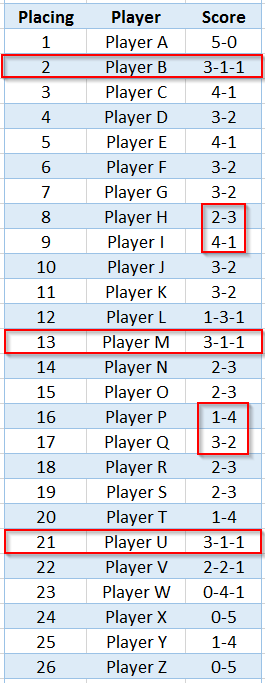
As we can see “3-1-1” score resulted in 2nd place for one player and 13th and 21st for others, which perfectly illustrates that rather than the overall number of wins for final standings the moment when a player won was more influential than the number of victories. The other examples are positions 8 and 9 and also 16 and 17. As last 2 points I won’t to mention that splitting all players into smaller pools lead to problems when players will leave in the middle of the tournament, which sometimes happen. With usual single pool system if you have uneven number of players and one player must leave the system works great (no more Bays, everyone get to play), but with players divided into pools, if the player leaving is from another pool than the one with uneven number of players (and Bay in place), it results in 2 players getting bay and not having to play. Not only players leaving are a bigger problem in 2 stage tournament – I expect that with such big impact of first 3 games some players may want to leave as with bad starts (third place in three way 2-1 tie is the worst example) they simply have no chance of bouncing back in the standings as their final standing is very limited (in the worst example, the best that this “unlucky” 2-1 guy can get is 9th when finishing 4-1. Quite demotivating huh? If you think this is quite unlikely scenario check the 9th place on a graphic above).
I believe I proved that there are big problems with the 2 stages approach, but let’s consider if there is a way to make it work. Most of the problems I listed come from very small size of pools in 2nd stage, but the number of rounds dictate the maximum size of a pool, so in my opinion the sad answer is that such system can’t work with 5 round tournament. However with 6 rounds the 2 stage tournament can work. It won’t be free from the issues I listed, but they will be much smaller. The main difference would be to double the size of second stage pools, so the “fixed” standings are less problematic. With 4 pools in both stages you can still lose a game in first stage and compete for the first place. Instead of strict pools there can be a “bracket stage” where worst players from a “pool” will compete in last round with best players from the “worst pool”, but this will simply make the final standings closer to what traditional swiss system would achieve and keep most of the problems of this system. Long story short – I believe such system could work, but only in specific situations and it is still worse than traditional swiss system.
Tournament scoring
Second element that was quite unique was the implementation of scoring in Age of Sigmar often called “small points”. Every game finished with both players getting a number of points that resulted in 20 when added together, in simpler words instead of minor/major victory the game would end with a score of 13-7 or 18-2. This made a lor of people extremely excited as granularity in scoring is an often discussed topic, but in the end it was used only as a first tiebreaker with Win/Lose/Draw being the main way of determining standings. W will quote the author: “One thing that we had to do is, we needed to adjust the point system to make it more interesting in a pool play, so that wasn’t just like if you won it was a straight 20-0 because the other person didn’t kill half of your warband. We needed to make point system more meaningful”. I completely agree with the idea that close objective/treasure game shouldn’t be major victory simple because the game was very bloody and the notion that 20-2 result in Victory Points is never a minor win regardless of how many models a player has at the end of the game, but the solution implemented in the tournament didn’t address this idea at all. In fact the final scoring was less granular as there were only 3 results of every game (win/lose/draw) instead of 5 with minor/major wins in place. The usage of “small points” (results in form of 11-9) while granting a lot of granularity for a tiebreaker proved ineffective as during tournament the 2nd and 3rd tiebreakers had to be used (head-to-head and result against common enemy), but this is mostly the result of only going with W/L/D system. 2nd stage of the tournament also required a winner, so the tiebreakers were not actually needed at this stage. The usage of “small points” as primary scoring for placing is connected with some risks and as we are overthinking everything here let’s talk about them for a second. I will start by saying that I don’t like them because in my opinion number of wins is more important than the matter in which they were achieved, otherwise “stomping beginners” and bringing very skewed lists (rick-paper-scissors style) is suddenly a “correct” decision. It is a result of simple fact that with standings based on “small points” the player A with results of 20-0, 20-0, 3-17 (43 points) finishes higher than a player that went 14-6, 14-6, 14-6 (42 points) and this is the situation that I personally don’t think is the correct solution. But there is no consensus on that and it might be a good idea to start discussing it as a community, especially when tournament formats evolve more and Nova (but also the current TTS tournament) is a great example of it.
As a last topic I want to go back to minor/major victory not coming from killing half of the winner warband which often has nothing to do with victory condition and doesn’t reflect the game at all. As you can see from my battlepack (you can check it here), but also a TTS tournament organised by theSaltySea (tournament pack here) there are solutions for that and I really hope that more players will hear about it as I believe it can eliminate some of the “feel bad” moments and strategic asymmetry when a winning player must worry not only about keeping the winning position, but also avoiding losing his models and losing player have a dilemma to either focus on victory condition to try to win/draw or go for kills to get “minor loss”.
 Overthinking Warcry