Despite the fact that Warcry isn’t the most complicated game (rules-wise), there is a lot of depth in it and great players have countless avenues to express their skill. Below I will show you 3 different things that will let you increase the speed of your growth. Despite quite limited (in comparison to games like Warcry’s bigger brother – Age of Sigmar) amount of information to keep track players often forgot/misinterpret important elements of the game, like battleplan details, reactions, abilities or details of fighter profiles. Making sure both you and your opponent have easier job tracking all important information will lead to a higher quality games and also to faster growth of both players, as you will avoid “bad practice” games decided by players forgetting about important stuff and with easy access to required information you can dedicated more brainpower to the game. The same will apply to your opponent and the better your opposition during trening, the better you are. TLDR = when you improve how you “store” information required for the game you decrease “mental load” and you can spend this freed resources on your tactics improving the quality of gameplay both for you and your sparing partner.
1. Try to prepare one sheet roster with all profiles and abilities of your warband
The title says it all, when you have all required information properly formatted you will always have all your profiles and abilities in front of you during games. Make sure to remove “dead” abilities, like for example bladeborn fighter abilities affecting only other fighters from the same Underworlds team, in a warbands where you don’t include this other fighters (you can see me skipping such abilities in my SBGL example below). The other way to make your warband sheet better would be to try (if possible) to keep fighter abilities next to the fighters that could actually use it. Below you can see example of warband sheet I prepared for the last tournament I played (I finished second, link to the file if you want to try the list yourself HERE):

If you are interested in other example of this, HERE is the Ironjawz list sheet I tested for the same tournament (and HERE is the article about that list creation) or more casual but way more challenging formatting wise Tzeentch casual list I played lately HERE.
If you don’t know how to create something like that, then I suggest starting with a table in a MS Word or Google Docs where you can copy profiles and abilities from Warcrier.net (highly recommend using this site) and moving from there.
With all your profiles and abilities in front of you it will be way more difficult to forget that your warband has access to some rarely used ability (like Calthia lantern that can suddenly be very helpful when opposing Horns of Hashut have access to triple of fives and triple of sixes)

You can also remove “bad abilities” (maybe consult it with some experienced players if you are a beginner) like most of the quads to remove the distraction of analyzing if they fit the situation.
2. Make sure all other information is also easily available for both players
Try to “outsource” keeping track of anything to convenient tools, for example lay down your phone next to the game board with app showing the points of both players (I use random app for keeping track of player life in MTG), so its clear for both players at all times, similarly keep a die with turn number next to your phone, it can make calculating the points from “scaling objectives” easier. Most importantly – make sure measurements you do in game are made in a way that is clear to your opponent, so he won’t have to do all of them in his turns. Making sure all information is clear and conveniently stored for your opponent is why you should ALWAYS have a copy of your roster for your opponent. If you want to take a single thing from this article and you are not already doing this, then a copy of your roster for your opponent is the thing to implement if you had to chose only one. Keeping things clear for both players also connects to measurements – when you deploy fighters barely outside of maximum threat range of enemy fighter than mention it (together with saying the distance) to your opponent, to limit the amount of things he has to consider and measure. Remember that the better your opponent the more valuable he is as your practice opponent, so to get better faster, help your friends get better too.
One last note on the topic – painted minis provide better clarity, so there is no excuse not to paint your minis. There is nothing worse than winning because your opponent can’t differentiate your threats from your chaff.
3. Don’t be afraid to format the rules and battleplan text to better fill your needs.
In one of examples I listed in 1st point there is a Tzeentch warband sheet. Some of the abilities might have a “dead text”, like for example reference to injury rolls in campaign games that is mentioned in Horrors reactions – delete this text if you are not playing narrative. The whole idea behind this article is that you should trim the fat from all information and improve the formatting and ovarall access to it, which sometimes leads to formatting or editing Games Workshop text. The most important place where you should do it is in description of battleplans. Let’s take a look at popular Rumble Pack battleplan:

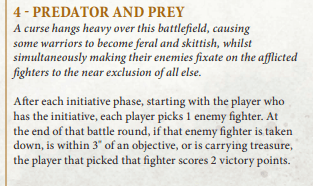
There are 3 different rules in a single paragraph and you can’t quickly reference them as they are inside a small “wall of text”, additionally Sidequest is on another page. Let’s quickly compare it with the draft of next version of by battlepack:
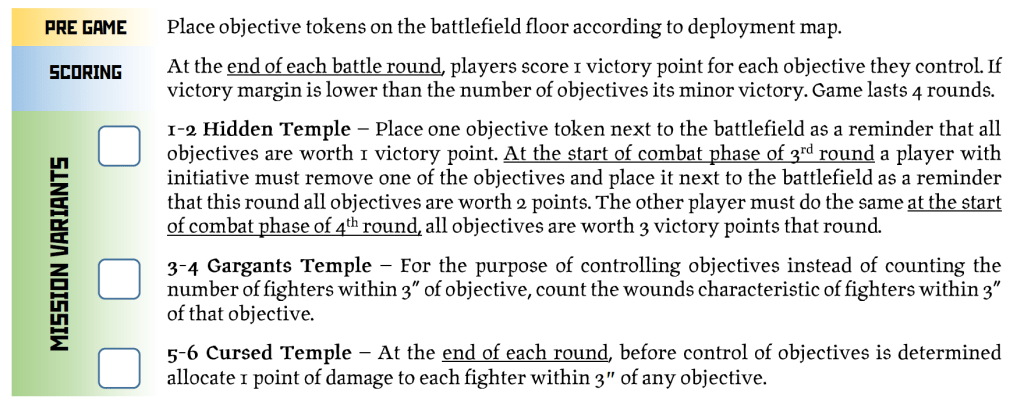
Similar amount of information is formatted in a way that makes referencing specific rule way easier. I also underlined all references to when specific rule gets “triggered”, but you can go even further and highlight other stuff, like for example the distances or places where one rule ends and the next one begins or anything else you find valuable and makes checking it easier and faster.
As always thanks for sticking to the end, merry christmas and I hope Santa knows which factions you play 😉
 Overthinking Warcry