My next post was supposed to by last, but writing it took so long that I decided to write one more small text, as the idea I want to present today certainly deserves separate article instead of a single paragraph.
Victory Points dictate everything in our games and help compare the results of players even if they play on different tables, but they also dictate which part of the faction toolset won’t matter in a game. Faction power depends on what is actually scored so playing a mission without treasures will negatively impact certain warbands (for example Sylvaneth or FEC), its the same for missions with no objectives (for Dispossessed) or with no scoring for kills (for Ogors). With my last project (path of glory battlepack) I tried to limit the negative impact the mission scoring has on a player warband and today we will tackle the same problem from slightly different angle.
Classic missions reward almost only two activities: controlling objectives and killing* (that sometimes also require picking something dropped by the body) specific targets. This led to a situation where “small and talls” is a kind of list that is the best at maximizing your killing potential and your numbers leaving midrange fighters awkwardly in the middle where they are not efficient enough for any of the usual wincons. For midrange fighters to shine there need to be something that is decreasing the value of a chaff the less durable they are, so increasing your numbers in the cheapest way has a cost (currently there is none) – this is another ingredient with which we are about to cook today.
The last topic I want to mention before going to the actual idea is that VP based games fail to correctly reflect potential results of an actual fight making the battlefield situation way more “gamey” that it has to be. In actual fight both sides can have different (sometimes unrelated) objectives which can lead to both sides winning or even both sides losing at the same time. Additionally pushing your advantage is often a bad idea as getting more VP than your opponent is your main goal and risking your victory is almost always a bad decision, but in another system where you care more about how the result of your games compare with all other players during event (instead of only caring about your opponent) there is way more decisions to be made and pushing your advantage (that now actually makes sense) opens an option for the opponent to catch back.
Chaos scoring
The basic idea behind the chaos scoring is that instead of having your various scoring methods (battleplans played today almost always have several different ways of scoring VP) that only matter in a context of a game they are played in they are summed and scored separately for the whole event. It may sound complicated, but its actually very simple: standard way of scoring in a situation where you play 3 games with objectives and kills scored will have your objective scores (and kill scores) only matter in the game they are scored. In the alternative system that I’m proposing the objectives scores will get summed and be tracked separately from kill scores. In such system to finish at the top it is not enough if you simply score more points than your opponent – you must beat the results that other players had in their games.
I mentioned midrange fighters earlier not without a reason. The separate scoreboards will include one specifically designed to reward players that care about durability of their fighters and not only about their numbers. Lets get to the 4 scoreboards:
Chosen of Khorne – Good old kill points (at the end of the game, so no resurrection bullshit allowed). It makes every game a kill mission (or Reaper to be specific) and makes going for a kill a good idea in every situation.
Chosen of Nurgle – You get a point for every fighter that survived the battle (no resurrection bullshit allowed). This is the big opportunity cost for running small&talls warband and a counterbalance for kill points and risky aggressive plays.
Chosen of Slaanesh – You get a point for every treasure you control at the end of the game. Every game is a treasure game so treasure oriented warbands can always have fun with their toys and scoring at the end of the game makes it a bit less horde friendly than scoring every round.
Chosen of Tzeentch – The most classic objective scoring there is – one point for every objective, every round. To not make the overall scoring too horde friendly I suggest to not run missions with a lot of objectives (3-4 for most games seems the best). Just like above, objective focused warbands will always have access to their tools.
How do I win?
Having your players place differently in 4 different scoreboards is not actually very helpful for determining a single winner or producing pairings for every round, so we need a 5th one:
Everchosen A.K.A. Best Overall/Best General – just use average placement, you can add the player placements (3 for third + 8 for 8th + …) from all four scoreboards listed above and reverse the order to get “final scoring”.
One last element we need is a tiebreaker for best general scoreboard and the obvious choice here is to use our 4 thematic scoreboards in some order (for example Khorne as primary tiebreaker, Nurgle as secondary etc.). TO can pick the tiebreakers order to promote certain playstyle or simply randomize it, either way the system isn’t complicated.
Why it’s cool
The main advantage of Chaos Scoring is that every kill, treasure and objective in the game matters. Indirect effect of the last sentence is that there is basically no reason to surrender, which is great if you ask me.
The next great thing is the scalability of goals. Beginner can focus on scoring specific God while experienced player not only have the usual best general, but also gets more avenues for skill showcase and skill expression (checking differences between player scores will show you which scoreboards will be easier to advance in). There is also an infinite potential for friendly bragging when your Stormcasts are higher on a Nurgle scoreboard than your friend Maggotkin list. The system also let’s you track domination level as one event can be won by the player that was first in all scoreboards, while another can be won by a person with combined 2nd, 2nd, 4th and 6th.
While at the first glance chaos scoring seem incompatible with most scoring mechanics or battleplans in general it’s only a matter of rephrasing the specific God scoring method. For example the Haunted mechanic where you score for killing specific targets can alter the way how you score on Khorne scoreboard (for example you multiply the kill points for haunted targets, or use flat points bonus for killing Haunted targets. Similarly nothing stops you from having inactive objectives or lootable treasures)
For more narrative driven/casual events you can add additional rewards and incentives for winning specific God scoreboards (heroic trait for your leader for as long as you are first). You could also consider themed catch-up mechanics for players at the bottom of scoreboards.
Obviously this system expands your prize options, which actually makes some prizes seem less impossible to win for less experienced players.
Chaos scoring is also more intuitive and leads to game decisions that are easier to understand. Even for people that don’t know the game – it becomes more spectator friendly, which matters for tournaments or streaming.
The system is interesting and unusual so giving it a chance might make the game fresh for longer, but it also applies some limitations on battleplans, so I think it shouldn’t be considered as a replacement for classic VP/TP based system.
There won’t be any more “in between” articles, so the next one is the last. As always I hope I managed to inspire or at least was entertaining to read. Next text is about list building in general, so it was the last time I had the pleasure to flex my unimpressive game design muscles and as always I had a lot of fun doing it. It’s also my first article post FAQ, so I’m very happy the game is alive, but the execution of the FAQ suggest that despite releasing some rules James Workshop actually doesn’t care much and I don’t think it’s enough to stop or reverse local player bases shrinking in certain places.
Every year since 2023 a new battlepack was published here and I wanted to also design one for this year, as its not only a lot of fun, but also huge motivation boost when I see it used and hear a lot of positive feedback. This year I decided that due to expected drop of 3rd edition I should do it way faster than with the previous releases, that were always in last quarter of the year. If you are here only for the link to the actual battlepack, here is the LINK, you can also get there through the Battlepacks Tab on top of the page.
Last pack released by GW called Ferocious Gnarlwood II surprisingly didn’t include any treasure mission, which made me think a lot about balancing different types of victory conditions. “Relatively” recent faction reworks GW did made me think that FEC players would love a pack with only treasure missions, similarly Dispossessed with their crazy objective control would prefer return of the Rumble Pack meta. Speaking about Rumble Pack – despite many people hating the meta I remember that fights between tuned lists of strong factions were super fun and very strategic back then. Putting all this together I started to think if I could make a battlepack that will satisfy a FEC player that only wants treasure missions and dwarf player that want objectives every game. The answer is – yes, let me explain.
To make this strange idea possible we must firstly drop the concept of all players playing the same mission each round as in our example the only way to keep it would be to include every victory condition in every battleplan which would make it boring, complicated and relatively easy to “solve”.
If battlepack is to be dictated by a player choice of preferred victory condition, we need to pick a list of options player may chose and simply going for 3 paths focused on killing, objectives and treasures means that you will very often play against the same path and there will be multiple players playing the same path even in a 4 player group, which doesn’t feel right, so let’s make it possible to also select mixed wincons, for players that want a bit more variety or simply don’t want to skew their list to the extreme that focusing on simple victory condition might require. This way we are left with 6 paths and lets treat them as 100% of single victory condition or a 50%/50% split. As we will construct battleplans based on two paths and we will add this vales together, lets split them so they will sum up to 100% instead of 200% and write some descriptions to add some flavor that I’m sure narrative players will appreciate and that could help pick the path for players that are a bit less serious about listbuilding or the game in general (if you are interested in this descriptions just head to the battlepack PDF).
The Paths:
Path of Conquest (Objective focused)
Path of Power (Objective and Treasure focused)
Path of Domination (Objective and Kill focused)
Path of Honor (Kill focused)
Path of Glory (Kill and Treasure focused)
Path of Greed (Treasure focused)
Now when we have the paths figured out we need some missions. Lets look at simple example: 25% treasure 25% kill path (Path of Glory) playing against 25% objective and 25% treasure path (Path of Power) will end up with a battleplan that is 50% treasure, 25% objective and 25% kill. The same battleplan will also be a result of a 50% treasure path (Path of Greed) meeting 25% objective and 25% kill path (Path of Domination). This approach where the same battleplan can be created in multiple ways is dropping a number of battleplans we need to create to 15 (every single path only has 6 missions they can play). One last addition would be an extra mission equally focused on every victory condition that is there as an option for a player that would not want to play the same mission twice which might happen when we have more than 6 players (2+ players on the same path). Lets go to the main part of each battlepack – battleplans:
Battleplans
The table below shows Battleplan numbers that each path could play:
O
O/T
O/K
K
K/T
T
O
I
II
III
IV
V
VI
O/T
II
VI
V
VII
VIII
IX
O/K
III
V
IV
X
VII
VIII
K
IV
VII
X
XI
XII
XIII
K/T
V
VIII
VII
XII
XIII
XIV
T
VI
IX
VIII
XIII
XIV
XV
Before we move to the mission descriptions I just want to mention that my intention for battleplans was “simplicity whenever possible”, as because of the nature of the pack I had to include few missions that had all 3 victory conditions and they had to be more complex because of that
Other common elements for the pack was avoiding “my side/your side” style of maps as they enhance shooting and running away from action and my intention is to promote fun and interactive gameplay. For the same reason I also kept the average number of objectives low. Whenever I design missions I try to find ways to reward faster warbands as the first part of 2nd edition was dominated by a very slow fighters. I also try to minimize the impact of luck on scoring (no single treasure missions or extra VP on objectives based on initiative) and keep deployment points in a safe distance to limit the impact of a first round Rampage.
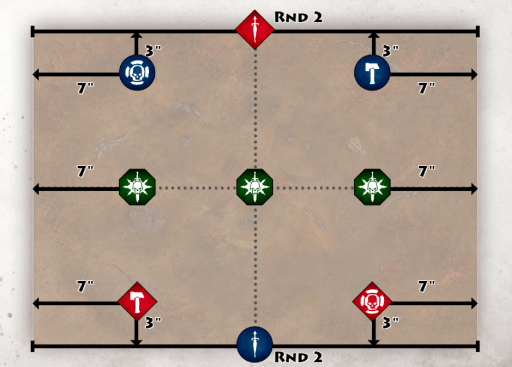
I Conquerors Duel (100% Objective)
Setup: Place 5 objective tokens according to the deployment map. Scoring: At the end of each battle round, Players score 1 VP for each objective they control.
Very simple mission with interesting map. I was debating whether the “scaling” objectives was the better choice, but in the end I figured out that 100% objective focused mission should be about positioning and activation advantage and not “outsurviving” the enemy (which feels more “killy”). The map already creates plenty opportunities to fight, so I believe that in this case “less is more”.
II Rings of Power (75% Objective 25% Treasure)
Setup: Place 4 objective tokens (green) and 2 treasure tokens (black) according to the deployment map
Scoring: At the end of each battle round, Players score 1 VP for each objective they control and additional VP coming from Rings of Power enchantments.
Rings of Power: Every round after Initiative and in order of Initiative Players having treasures must pick one objective to be enchanted for that round. Player having 2 treasures can pick two different objectives or pick the same objective twice. Controlling enchanted objective grants one additional VP per every enchantment
I wanted one of the missions with small treasure focus to introduce a new function for treasures. My idea was to have it somehow related to scoring, but not in a usual, direct way, but through the other, primary scoring method. Additionaly I wanted it to have counterplay, so both players have a full round to react to it before the scoring happens. Treasure addition also breaks the usual preference to go second in objective mission which is another strong point. I hope the “controversial” name will not scare players away (I hate that show too) and instead inspire some conversations among players.
III First Strike (75% Objective 25% Kill)
Setup: Place 4 objective tokens according to the deployment map. Scoring: At the end of each battle round, Players score 1 VP for each objective they control. In addition first kill of every round grants 1 VP
First of the deployment maps recycled from my previous packs, I hope it looks familiar. The mission is very simple and as in previous one I tried to add more interest to “who goes first in a treasure mission” decision. The distance to opponent might seem high, but as the primary focus isn’t on killing here its a conscious decision.
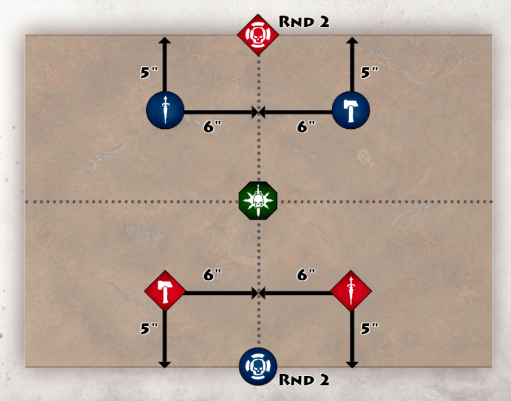
IV Hidden Tunnel (50% Objective 50% Kill)
Setup: Place 4 objective tokens according to the deployment map
Scoring: At the end of each battle round, each Player scores 1 victory point for each objective they control. In addition, whenever a fighter takes down another fighter while both are contesting the same objective, that fighter’s controller scores 1 victory point
This mission is a mashup of a classic “Might Makes Right” mission (a lot of people will know it from theSalty Sea battlepack, but I believe it was first introduced by GW on one of victory cards – please let me know if I’m wrong here) and a great map designed by Norcry TO – Magnus. As I said in missions with heavy objective focus I tried to start the game with high distance to opponent, but due to the equally high focus on killing I decided its a perfect place for very aggressive R2 deployment that will let kill focused warbands have their fun too 🙂 As previously, “who goes first” is also far from obvious here (at least in later rounds).
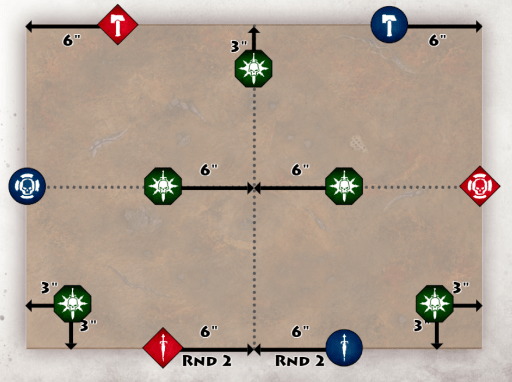
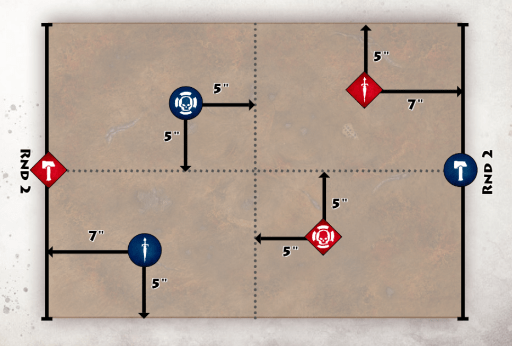
V Gorewyrms Nest (50% Objective 25% Kill 25% Treasure)
Setup: Place 3 objective tokens according to the deployment map. Scoring: At the end of each battle round, Players score 2 VP for each objective they control. In addition after 4th round Players score 1 VP for each fighter carrying treasure Gorewyrms: Objectives can be targeted by melee and ranged (remember that fighters within 1” can prevent that) attack actions and have Toughness 2. Count wounds inflicted by both players separately and after a fighter deals 20th wound remove this objective from the game and now that fighter carries treasure (and must drop it as bonus action if it can’t carry treasure)
With this mission I tried to implement an alternative method of “attacking” objective where you can’t hope to outnumber your opponent. Deployment map is preventing Ogors from attacking objectives in first round which is a must here and while shooting is certainly dangerous, falling behind in VP is more dangerous, as after removing the objectives there may not be enough scoring opportunities to catch up, so shooting instead of running to objectives might not work. In the end speed might be the best approach. I was hoping this mission will feel like a race.
VI Extraction (50% Objective 50% Treasure)
Setup: Place 3 objective tokens according to the deployment map
Scoring: At the end of each round, Players score 1 VP for each objective they control. Then, they pick one of the fighters contesting that objective to be carrying Treasure. If none of that Player’s fighters can carry treasure, they instead place the treasure on the battlefield floor, within 3” horizontally of the objective. Remove objectives from the battlefield once they have been controlled by a player at the end of a round. At the end of round 4, Players score 1 VP for each treasure they control.
I stole the mission description from theSaltySea’s (best Warcry youtube channel) Tidal Pack, but changed the map as I’m not a fan of a clear “my side/your side” separation of the original. Deployment points location could be a bit more clear, but I didn’t want to redraw all the maps in different tool (I used Optimal Game State tool and I highly recommend it together with OGS youtube channel. I wish my content looked half as good as his). I think its a solid mission where more numerous warband may force a tie on objective to delay treasure spawn. Its certainly risky, but can give enemy big guys less time to win back the treasures.
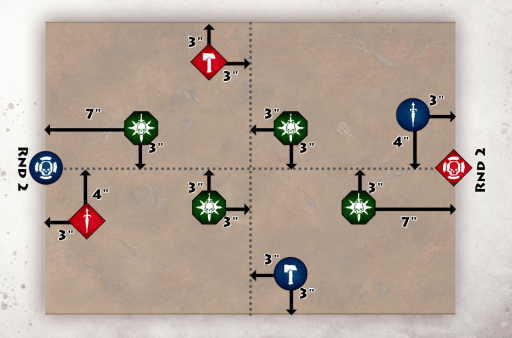
VII Cursed Well (50% Kill 25% Objective 25% Treasure)
Setup: Place 1 objective token according to the deployment map.
Scoring: At the end of each battle round, the Player that controls objective picks one of the fighters contesting that objective to be carrying Treasure. If none of that Player’s fighters can carry treasure, they instead place the treasure on the battlefield floor, within 3” horizontally of the objective. At the end of each round, Players score 1 VP for each treasure and 2 VP for each fighter taken down that round.
On the surface this mission is similar to previous one, but here the treasures serve more as an incentive to come to the center to make scoring through kills easier. You certainly can’t ignore the treasures as the combined number of VPs you could get from them is 10, but contesting objective means entering the threat range of enemy warband (also “alphablocking” opponent shield might look like an interesting alternative). Its supposed to be a good old brawl in the middle and due to low objective focus this mission wont be played by a player on “objectives only” path, as some of such factions could be slightly unbalanced here due to single objective. The “Smalls” from “Smalls and Talls” will have a bad time here and I see it as a feature, not a bug.
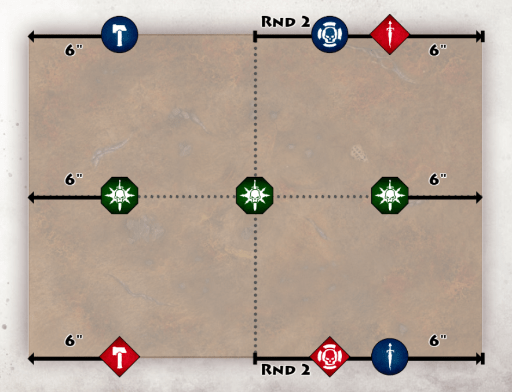
VIII Shrine of Bloodlust (50% Treasure 25% Objective 25% Kill)
Setup: Place 3 objective tokens according to the deployment map
Scoring: At the end of each battle round, Players score 1 VP for each objective they control and 1 VP for each treasure they control
Bloodlust: The first time a fighter takes down another fighter where both are contesting the same objective, remove that objective from play and that fighter is now carrying treasure. If that fighter can’t carry treasure then place that treasure on the battlefield floor, within 3” horizontally of that fighter instead
This mission is a more treasure focused version of the previous battleplan with the action spread across the map. Smaller focus on killing also means you can’t alphablock enemy Hammer due to the line deployment. I hope this mission is distinctive enough to not be seen as a better/worse version of previous ones. I believe it is and hope to get feedback on this topic.
IX Temple of Greed (75% Treasure 25% Objective)
Setup: Place 5 treasure tokens according to the deployment map.
Scoring: At the end of each battle round, Players score 2 VP for each treasure they control. In addition, for each treasure carrier, Player having more fighters within 3” of treasure carrier (excluding all treasure carriers) score 1 VP.
This mission provides a sort of a “scoring gradient” for treasures, where secured treasure surrounded by friendly fighters is worth 3VP and heavily contested (more enemy fighters around) one is worth only 1VP (2VP – 1VP for the enemy). Running/teleporting away with the treasure without another friendly fighter nearby will lead to “only” 2 VP. Outside of unique scoring I hope the map design (another one I designed for previous battlepacks) is forcing interesting decisions and properly rewords faster units.
X Witch Hunters Nightmare (75% Kill 25% Objective)
Setup: Place 3 objective tokens according to the deployment map
Scoring: At the end of each battle round, Players scores 1 victory point for each objective they control. In addition, Players score 3 VP each time enemy POSSESSED fighter is killed
Possessed: When a player activates a fighter, the enemy fighter used in the previous activation that battle round becomes POSSESSED until the end of the current activation. Enemy fighter is not losing POSSESSED status between chained activations (from Inspiring Presence like ability) unless activations are chained because other player has no activations left, in which case fighters no longer get POSSESSED that round. Getting POSSESSED the second time in a round deals D6 damage.
Another mission where secondary scoring exists mostly to lure fighters closer to the enemy. The POSSESSED mechanic is changing the way that both Tempo and Activation Advantage interacts with scoring in a kill mission. Going first in a kill mission (at least in later rounds) used to be a no brainer, but here the first activation (and often the last ones too) have no POSSESSED fighter to kill. Having more activations is advantageous, but wait actions can sometimes be punished by “counterwaits” that will lead to D6 damage. I’m quite proud of this mission and hope people will like it like I do.
XI Reaper’s Toll (100% Kill)
Scoring: At the end of each battle round, each Player totals the points values of enemy fighters taken down in that battle round. The result is their blood tally. If one player has a higher blood tally, that player scores 1 victory point.
Its basically Reaper with a new map that is supposed to weaken some of more “‘cowardly” strategies (“your side/my side” of the original map made running away a legit strategy and we don’t want that in 100% kill focused battleplan). I know Reaper has some problems but players on “Kill only!” path should be ready to deal with them and Reaper is a classic at this point so I think it fits here perfectly.
XII Reclaim our Relics (75% Kill 25% Treasure)
Scoring: At the end of each battle round, Players score 1 VP for each treasure they control. In addition, whenever a THIEF is taken down, the opposing Player scores 1 VP, even if that THIEF is no longer carrying treasure
Thieves: After deployment in the 1st battle round, the Players roll off. The highest roll picks two fighters in their opponent’s warband to be THIEVES. Both fighters must be on the battlefield. Then, the other Player does the same. All THIEVES are carrying treasure. If a Monster or Beast is picked as THIEF, that fighter immediately drops the treasure.
This is the only instance were the whole battleplan (both the map and the wincon) is “borrowed” from another pack (the map has deployment groups changed and I removed D6 damage for carrying treasure close to the edge). Its my favorite mission from Tidal Pack and I knew from the beginning that the THIEF mechanic will appear in the pack. Very good mission that should fit most tournament packs (I know that the 75% kill 25% treasure might not be the most accurate here, but playing this map feels like a hunt).
XIII Bloody Trophies (50% Kill 50% Treasure)
Scoring: At the end of round 4 Players score 1 VP for each fighter carrying treasure
Bloody Trophies: First 3 times the fighter who is not carrying treasure kills the enemy fighter it immediately starts carrying treasure. If this fighter can’t carry treasure place that treasure within 3” of that fighter instead.
You can probably guess that lack of treasures in last GW Pack inspired me to experiment with them a lot. I think one of the strengths of this map is that despite its simplicity it creates quite “healthy” listbuilding pressure. It rewords durability and is a rare case where 3 model list is a legit threat (Karkadrak with 2 FOMO or 3 Tyrants is not something you want to meet here). I think the listbuilding default requirement of 7+/8+ models minimum should be challenged more often and I hope missions like this can help inspire more diverse meta.
XIV Dragon’s Hoard (75% Treasure 25% Kill )
Setup: Place 6 treasure tokens according to the deployment map
Scoring: At the end of each battle round, Players score 2 VP for each treasure they control. In addition Players score 1 VP every time opponent treasure is dropped (due to killing a treasure carrier or as an action).
Another simple concept: a lot of treasures with extra incentive for attacking enemy treasures. Picking up treasure with a model unlikely to survive the round might not be a good plan here. Finding the correct number of threats for your list in this mission is more challenging than it seems.
XV River of Gold (100% Treasure)
Setup: Place 5 objective tokens according to the deployment map.
Scoring: At the end of round 4 Players score 1 VP for each fighter carrying treasure
Looting: fighter within 1″ of an objective can loot that objective as an action. If they do, that fighter is now carrying treasure and cannot use an action to drop that treasure. If a fighter that cannot carry treasure loots an objective, that fighter immediately drops that treasure as a bonus action. After loot action is made within 1″ of an objective, remove that objective from the battlefield.
Loot and Pillage is a classic and there isn’t a better type of mission for a showdown of two heavily treasure oriented lists. Paired with the most popular map I created, this is a very strong battleplan that was already played during few events and received overwhelmingly positive feedback. I really recommend this mission.
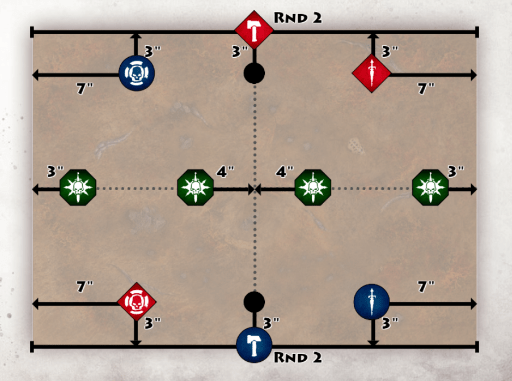
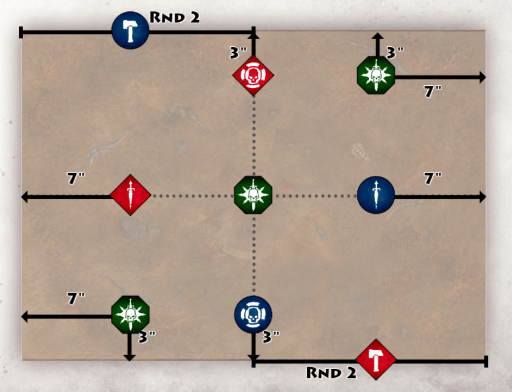
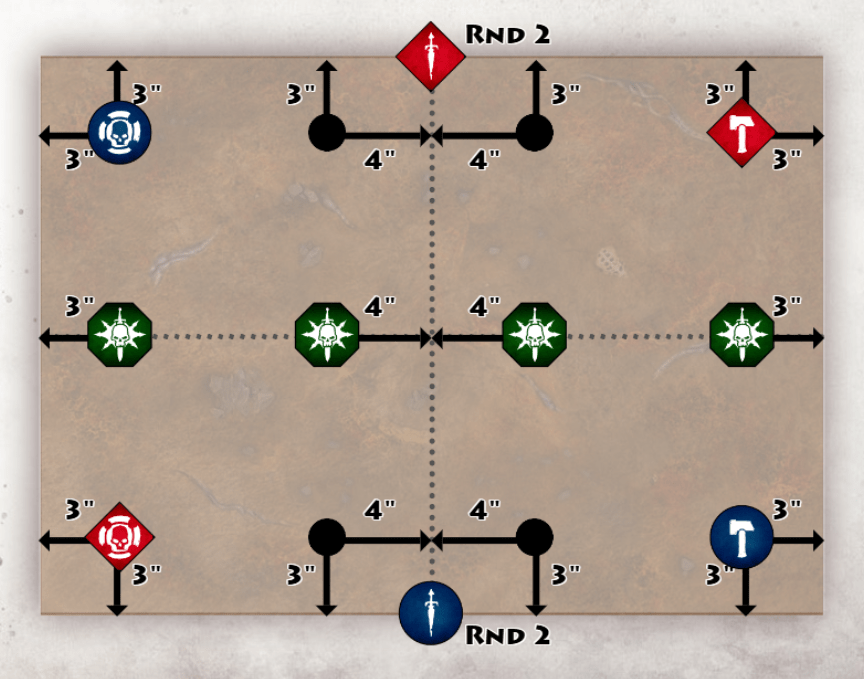
XVI Jack of all trades (33% Objective 33% Treasure 33% Kill)
Setup: Place 4 objective tokens (green) and 4 treasure tokens (black) according to the deployment map
Scoring: At the end of each battle round, Players score 1 VP for each of the following that is true:
you control more objectives than your opponent
you control more treasures than your opponent
you have higher BLOOND TALLY than your opponent
Blood Tally: Total points value of enemy fighters taken down in that battle round
The first draft of this mission called “Everything everywhere all at once” had a bit different RND2 deployment. It caught the interest of Norcry TO – Magnus who adjusted it to current state in which it was already used in 2 big tournaments last month (Norcry and TTS league) and judging from the feedback I expect more TO to use it. In this battlepack this mission serve as a backup to prevent players from heaving to repeat one of the previous battleplans.
Closing thoughts
I was expecting the pack to be used mostly for casual meetups, but before publishing this I already heard two TOs expressing interest to run the whole pack during event, so maybe I underestimated how popular it will get.
When I shared the pack with local group it was pointed to me that GW already published something similar in WD 502 called “Paths of the chosen”, so if you like the concept you can look for another implementation there (its a narrative campaign).
As always thanks for reading and I hope this article was entertaining and inspiring. Please consider giving my pack a chance or at least try some of the missions. If you enjoy my articles and battleplans I design, you can support me on Patreon.






 Overthinking Warcry