My next post was supposed to by last, but writing it took so long that I decided to write one more small text, as the idea I want to present today certainly deserves separate article instead of a single paragraph.
Victory Points dictate everything in our games and help compare the results of players even if they play on different tables, but they also dictate which part of the faction toolset won’t matter in a game. Faction power depends on what is actually scored so playing a mission without treasures will negatively impact certain warbands (for example Sylvaneth or FEC), its the same for missions with no objectives (for Dispossessed) or with no scoring for kills (for Ogors). With my last project (path of glory battlepack) I tried to limit the negative impact the mission scoring has on a player warband and today we will tackle the same problem from slightly different angle.
Classic missions reward almost only two activities: controlling objectives and killing* (that sometimes also require picking something dropped by the body) specific targets. This led to a situation where “small and talls” is a kind of list that is the best at maximizing your killing potential and your numbers leaving midrange fighters awkwardly in the middle where they are not efficient enough for any of the usual wincons. For midrange fighters to shine there need to be something that is decreasing the value of a chaff the less durable they are, so increasing your numbers in the cheapest way has a cost (currently there is none) – this is another ingredient with which we are about to cook today.
The last topic I want to mention before going to the actual idea is that VP based games fail to correctly reflect potential results of an actual fight making the battlefield situation way more “gamey” that it has to be. In actual fight both sides can have different (sometimes unrelated) objectives which can lead to both sides winning or even both sides losing at the same time. Additionally pushing your advantage is often a bad idea as getting more VP than your opponent is your main goal and risking your victory is almost always a bad decision, but in another system where you care more about how the result of your games compare with all other players during event (instead of only caring about your opponent) there is way more decisions to be made and pushing your advantage (that now actually makes sense) opens an option for the opponent to catch back.
Chaos scoring
The basic idea behind the chaos scoring is that instead of having your various scoring methods (battleplans played today almost always have several different ways of scoring VP) that only matter in a context of a game they are played in they are summed and scored separately for the whole event. It may sound complicated, but its actually very simple: standard way of scoring in a situation where you play 3 games with objectives and kills scored will have your objective scores (and kill scores) only matter in the game they are scored. In the alternative system that I’m proposing the objectives scores will get summed and be tracked separately from kill scores. In such system to finish at the top it is not enough if you simply score more points than your opponent – you must beat the results that other players had in their games.
I mentioned midrange fighters earlier not without a reason. The separate scoreboards will include one specifically designed to reward players that care about durability of their fighters and not only about their numbers. Lets get to the 4 scoreboards:
Chosen of Khorne – Good old kill points (at the end of the game, so no resurrection bullshit allowed). It makes every game a kill mission (or Reaper to be specific) and makes going for a kill a good idea in every situation.
Chosen of Nurgle – You get a point for every fighter that survived the battle (no resurrection bullshit allowed). This is the big opportunity cost for running small&talls warband and a counterbalance for kill points and risky aggressive plays.
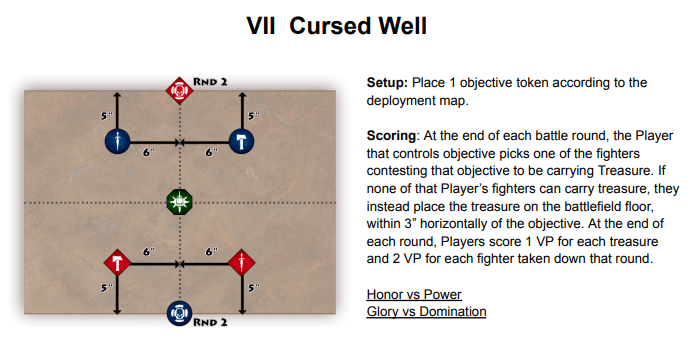
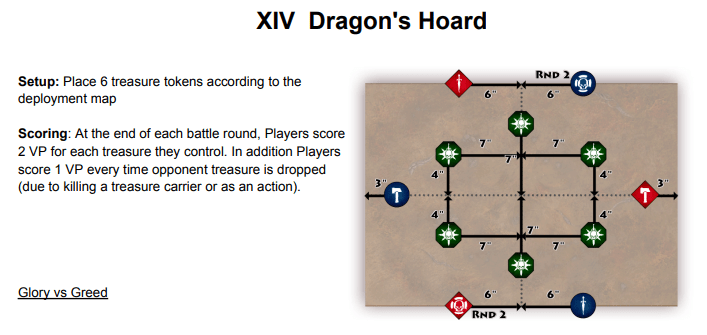
Chosen of Slaanesh – You get a point for every treasure you control at the end of the game. Every game is a treasure game so treasure oriented warbands can always have fun with their toys and scoring at the end of the game makes it a bit less horde friendly than scoring every round.
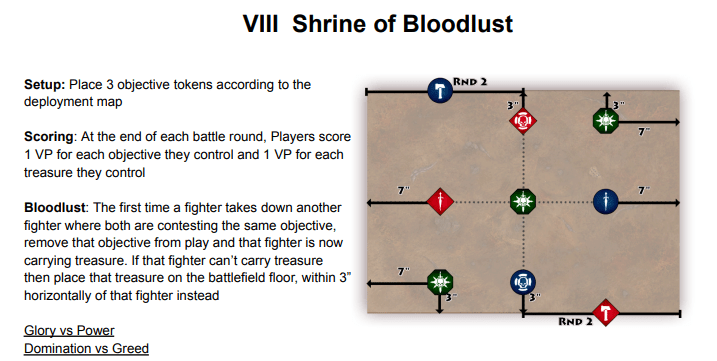
Chosen of Tzeentch – The most classic objective scoring there is – one point for every objective, every round. To not make the overall scoring too horde friendly I suggest to not run missions with a lot of objectives (3-4 for most games seems the best). Just like above, objective focused warbands will always have access to their tools.
How do I win?
Having your players place differently in 4 different scoreboards is not actually very helpful for determining a single winner or producing pairings for every round, so we need a 5th one:
Everchosen A.K.A. Best Overall/Best General – just use average placement, you can add the player placements (3 for third + 8 for 8th + …) from all four scoreboards listed above and reverse the order to get “final scoring”.
One last element we need is a tiebreaker for best general scoreboard and the obvious choice here is to use our 4 thematic scoreboards in some order (for example Khorne as primary tiebreaker, Nurgle as secondary etc.). TO can pick the tiebreakers order to promote certain playstyle or simply randomize it, either way the system isn’t complicated.
Why it’s cool
The main advantage of Chaos Scoring is that every kill, treasure and objective in the game matters. Indirect effect of the last sentence is that there is basically no reason to surrender, which is great if you ask me.
The next great thing is the scalability of goals. Beginner can focus on scoring specific God while experienced player not only have the usual best general, but also gets more avenues for skill showcase and skill expression (checking differences between player scores will show you which scoreboards will be easier to advance in). There is also an infinite potential for friendly bragging when your Stormcasts are higher on a Nurgle scoreboard than your friend Maggotkin list. The system also let’s you track domination level as one event can be won by the player that was first in all scoreboards, while another can be won by a person with combined 2nd, 2nd, 4th and 6th.
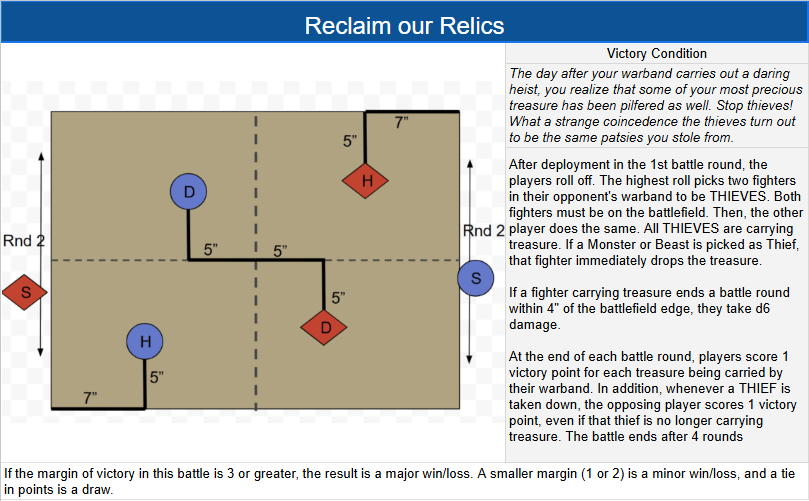
While at the first glance chaos scoring seem incompatible with most scoring mechanics or battleplans in general it’s only a matter of rephrasing the specific God scoring method. For example the Haunted mechanic where you score for killing specific targets can alter the way how you score on Khorne scoreboard (for example you multiply the kill points for haunted targets, or use flat points bonus for killing Haunted targets. Similarly nothing stops you from having inactive objectives or lootable treasures)
For more narrative driven/casual events you can add additional rewards and incentives for winning specific God scoreboards (heroic trait for your leader for as long as you are first). You could also consider themed catch-up mechanics for players at the bottom of scoreboards.
Obviously this system expands your prize options, which actually makes some prizes seem less impossible to win for less experienced players.
Chaos scoring is also more intuitive and leads to game decisions that are easier to understand. Even for people that don’t know the game – it becomes more spectator friendly, which matters for tournaments or streaming.
The system is interesting and unusual so giving it a chance might make the game fresh for longer, but it also applies some limitations on battleplans, so I think it shouldn’t be considered as a replacement for classic VP/TP based system.
There won’t be any more “in between” articles, so the next one is the last. As always I hope I managed to inspire or at least was entertaining to read. Next text is about list building in general, so it was the last time I had the pleasure to flex my unimpressive game design muscles and as always I had a lot of fun doing it. It’s also my first article post FAQ, so I’m very happy the game is alive, but the execution of the FAQ suggest that despite releasing some rules James Workshop actually doesn’t care much and I don’t think it’s enough to stop or reverse local player bases shrinking in certain places.























 Overthinking Warcry