
Battlepack is something that will shape experience of a tournament player to the same degree as the opposing warbands. The victory condition will dictate if a matchup against 6 Stormcasts will be a challenge (some kill missions) or a walk through the park (objective mission with many objectives). Similarly deployment map can make or break a slow warband.
I will analyze 3 most popular battlepacks (All of them are available from the Tab on the top of the page): Core Book Missions and “Rumble Pack” released by GW and Tidal Pack published by theSaltySea (I strongly recommend his Youtube channel). To make it more digestible I will split it into separate posts. Let’s start with the oldest and the simplest of the three:
Core Book Battlepack
This Battlepack has 6 battleplans, lets check them one by one and then analyze the whole battlepack. (The images come from warcrier.net – the best online resource for Warcry)
TREASURE HUNTERS
Battleplan with 5 Treasures. The player with more treasures after 4th round wins the game.

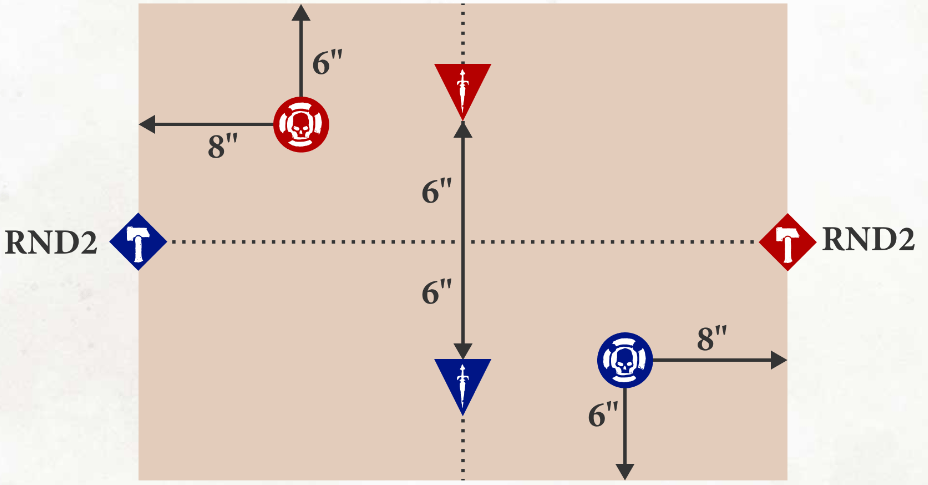
Uneven number of treasures and their location (2 in each player controlled area and only 1 in no man’s land) makes winning initiative very important. Distance to objectives makes “Inspiring Presence tricks” weaker than usually. Deployment zones split control over the map in half and winning initiative dictate which player will have to go to opposing side. Uninteresting deployment map with Dagger and Shield starting very close. This Design can lead to frustrating games if A) You play slow warband and lose initiative first round, B) Your opponent play slow warband (most of the warband points spend on combat stats instead of mobility) and you lose initiative first round. Despite of all of the above – it’s one of the best missions in this battlepack, as number of treasures to some degree mitigates disproportional advantage of winning initiative. Great battleplan for Sylvaneth thanks to teleporting tree.
THE CURSED RELIC
Single objective that deals D6 dmg to the bearer at the end of his activation. The bearer of this objective after 4th round wins or if there is none the player with more fighters within 3″ of it wins.

Single treasure makes initiative of first round the most important roll of the game. Deployment map is only slightly better than the last one with addition of Shields deploying “behind enemy lines” in round 2. All the action happens around single area of the map – treasure location. This makes monsters more dangerous than usually as they need to spend less actions on moving (there is only one place to be) and once they get where they want to be opponent can’t avoid them. This mission often ends in huge brawl around the treasure.
NO QUARTER
The player with more battlefield quarters that have their fighter wholly within it after 4th round wins.

As both players are everywhere on the map this battleplan often starts with “chaff hunting” in early rounds on both sides and in many cases ends with a draw. This winning condition isn’t very exciting and the deployment map from the first battleplan (very clear player territories that doesn’t work there) would force you to fight your way to reach battlefield quarters on your “opponent side”, instead its a chaotic, unexciting skirmish that often ends with a draw.
REAPER
Every round the player that killed more points of enemy models that round scores 1 VP.
I believe that the requirement to not “roll poorly” to win the game is wrong and that the game shouldn’t be decided by who rolls crits better. I am aware that there is more required for winning in Reaper than what I just said, but I believe (and cost assigning algorithm seams to agree) that the game should be about movement and positioning first and killing second. This mission grants “unfair” advantage for a player with access to Quad and for shooting warbands. It also promotes uninteractive gameplay when you get early advantage and is usually won by the team with the biggest threat. Despite my problems with the Victory Condition this mission is often full of very important dice rolls and is generally exciting if it doesn’t start with 2-0.
LEY LINES
Mission where 4 Objectives start the game inactive and the center one active. Every round the player without initiative activate one of objectives. Every round you score 1 VP for each active objective you control.

Another mission where initiative roll can give you advantage, but this time you have to lose initiative to get it and the reward is less significant. I’m not a fan of this battleplan, but it’s not as bad some of the other Core book missions. It’s a decent objective mission.
THE HIDDEN VAULT
Each player removes one of the objectives over the game and the last remaining is scored after 4th round.

This isn’t the worst mission despite the fact that it has almost all the “worst” elements of objective mission – it has single objective, it is scored only at the end of forth round and the “gimmick” with removing objectives will result in fighting over middle objective in a great majority of games. The aspect I like the most about it (or the way I like to approach such missions) is that its a 3 rounds of kill mission with no scoring and its a single round of objective game after that.
Battlepack Strengths
The main advantage of this battlepack is its simplicity. Most of the missions can be played as introduction missions and every beginner should be able to grasp the general idea of the missions. It is also quite good for people with analysis paralysis or people that like to spend a lot of time considering different directions they can go. Most of the missions are one-dimensional and usually the road for victory of both players is quite clear (you can’t get more basic than single treasure/objective) which leads to relatively fast games. Simplicity is also great for less competitive minds that want a bit more relaxed experience.
This battlepack also brought some much needed standardization to our community. It helped hardcore tournament players, content creators, beginners (basically everyone) as we knew what to expect from future events and had common context for analysis.
Battlepack Weaknesses
The main problem with this battlepack is lack of deployment group balance/symmetry. Dagger starts the game in first round in every mission where you have 4 rounds of scoring. It also starts round one the closest to treasures in both treasure missions. On the other hand Shield is (outside of Reaper) deployed in second round in missions when scoring happen every round, it is the only one deployed in the corner and has the highest average distance to first and second closest treasure/objective out of all deployment groups (to make matters worse – Dagger is the closest in both cases), so Shield is definitely the worst deployment group which is a shame as it is your main force flanking your opponent in case of losing initiative in Cursed Relic.
Second big problem of Core Book matched scenarios is very high impact of first round initiative roll. In half of the missions lucky Initiative roll will grant early advantage and in case of Cursed Relic with tuned list this advantage is massive.
In general lucky dice rolls are reworded too much in the battlepack as outside of initiative mentioned above Reaper can also be won by random crits, which can be a good thing, but I expect Victory conditions to favor better strategist instead of better “dice roller”.

The fact that it was main tournament battlepack at the beginning of the season (way before monsters got nerfed) combined with generally small number of important areas on the map and scoring happening mostly after 4th round played huge part in monsters being oppresive, as it played to their strength perfectly. The character of battleplans promoted elite warbands with very big incentive on getting the biggest available threat, which isn’t a bad thing, but when playing more “horde” warbands wining conditions often reworded avoiding fighting for as long as possible, which definitly isn’t a good thing.
In next post I will take a closer look at “Rumble Pack” (link here), Take care everyone and as always, thanks for sticking with me to the end of this wall of text.
 Overthinking Warcry
One response to “Overthinking Battlepacks part I: Core Book”
[…] big battlepacks). If you are interested in previous parts, then here are the links to posts about Core Book, Rumble Pack and Tidal Pack. Today is the day that I release my own project so instead of usual […]
LikeLike