This is a second part in a series of posts dedicated to Battlepacks. Today we take a closer look at Rumble Pack (available through tab on top of the page), but if you missed previous one about Core Book, you can find it here.
WARCRY RUMBLE: GNARLWOOD CHAMPION
“Warcry Rumble: Gnarlwood Champion”, because this is the actual name of the battlepack that we will analyse today was released in 2022 and wasn’t popular at the start with a lot of people not being aware of its existence. Shocked by lack of popularity of new battlepack and the fact that many people discarded it without a single game or after few games without sidequests in play I wrote “Everybody should try Gnarlwood Champion battlepack” article on reddit. I’m glad I did because the positive reception of this post is the reason this blog exist. Going back to the topic – Rumble Pack slowly became more and more popular (as you can guess from my Core Book battlepack analysis I’m not the biggest fan of it) replacing Core Book missions as default tournament pack. With more and more popularity came more and more refinement and suddenly people realized that there is a class of Rumble-Pack tuned warbands that has substantial advantage over more “traditional” lists (Core Book was favoring elite lists and now horde was a way to go). Next step in “public perception” was understanding that there is a single requirement to join the “S tier” Rumble Pack factions – efficient and cheap fighter that you can build your list around (*with access to mobility increasing abilities). As current point cost algorithm favors 3″ move fighters, the warbands with cheap, 3″ move chaff started to dominate (with the exception of Horns of Hashut, where 4″ move Shatterer was a build-around fighter).

This is basically where we are now with what is the “internet opinion” of Rumble Pack (that is shared across our local gaming group). Even the huge Rumble Pack fan like me started to realize that heavily skewed towards hordes Battlepack isn’t the healthiest for overall “meta” and the game itself even despite few brilliant design elements. Speaking about design elements, there is a lot to unpack here, so lets start with unique Rumble Pack elements that didn’t exist in Core book missions.
First of all – deployment maps introduced single deployment group starting the game round one. I believe it is great as (in vacuum) it partially address 2 of the main balance issues that most people had at a time: monsters and 3″ move fighters. Monsters are weaker when in 67% of games they start the game in second round and slow fighters can’t utilize their very efficient combat stats when they start the game in second round and must use their actions to get into position. This element is strictly connected with the second unique characteristic of Rumble Pack – (almost) every battleplan has scoring that happens every round. Which also mean that slow fighters should only reach the closest objectives and monsters (that are the weakest in objective based missions with many objectives) should start at a disadvantage early (Victory Points wise). On the other hand the combination of this two elements made horde warbands extremely strong. Objective heavy battlepack with single deployment group starting in first round and 4 rounds of scoring is a perfect environment for numerous lists. What didn’t help is that the game time suggested in battlepack is only 60 minutes, which with heavy incentive for horde warbands would often lead to unfinished 4th round (or even 3rd with slower players) which is great for horde warbands that usually get early advantage due to ability to spread to more objectives usually without risking opponent attacks. Here comes another great element of the battlepack – Victory Points being the first tiebreaker. This may seam small but it gives the most cutthroat players incentive to play fast – instead of utilizing early advantage and deliberately playing slow to not finish the game in time (and winning as a consequence), the players who are not respecting “fair play” rules were forced to play fast instead to finish as many rounds as possible improving their tiebreaker situation. The way in which some of the elements of Rumble Pack interacted made me believe that GW designers are great and made me a fan of the pack. Some of their later decisions changed my perspective to way less positive, but let’s stick to the topic.
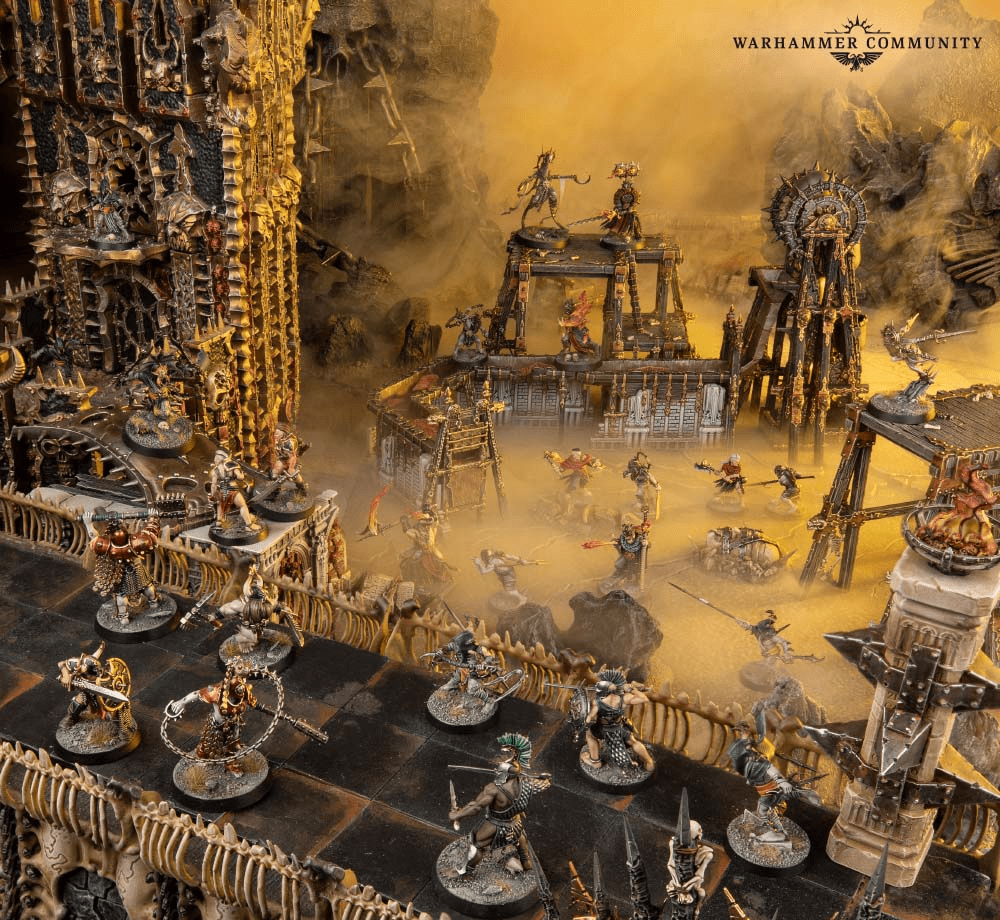
Definitely the most “innovative” part of the Rumble Pack are Sidequests. Its basically a secondary scoring element that is added to the main Victory Condition from battleplan. The fact that 5 out of 6 missions were objective missions with high number of objectives (add that to what I already told about the pack being great environment for hordes) made it almost ideal for numerous warbands and Sidequests seamed to serve 2 roles here: Reverse the heavy skew towards hordes by providing “elite friendly” ways of getting Victory Points and Increase replayability of the pack by creating 36 unique combinations of battleplan+Sidequest that differ in gameplay. Let’s take a closer look at them.
Sidequests:
STRONG-ARM THE COMPETITION
At the end of each battle round the player with the highest Wounds characteristics of the fighters in their warband that are within 3″ of the centre of the battlefield scores 3 victory points
RUN INTERFERENCE
At the end of each battle round score 3 victory points
if your warband controls an objective your opponent
controlled at the start of that battle round or one or more
enemy fighters dropped one or more treasures that battle round.
STOLEN WARES
Add 3 treasures worth 2 victory points each at the end of the game
PREDATOR AND PREY
Every round pick enemy fighter, if that fighter is taken
down, is within 3″ of an objective, or is carrying treasure,
you score 2 victory points.
CONQUERING THE LAND
At the end of each battle round, score 1 victory point for
each quarter of the battlefield that has 1 or more friendly
fighters wholly within it.
AN EARLY GRAVE
Get 2-5 victory points depending on how fast you can kill enemy leader
I don’t think it makes much sense to discuss sidequests in vacuum, so lets get back to them in the context of battleplans.
Battleplans:
LOOT AND PILLAGE
3 Objectives that can be looted (spend action within 1″ to get the treasure, only 2 loot “actions” per objective) with added rule that prohibits spending action to drop treasure. 2 VP per treasure scored after 4th round

Many players believe that this is the best treasure mission in Warcry and I agree with this statement. Deployment map is assigning 3 clear and different roles to every deployment group – Daggers are meant to defend your “home treasures”, Shield is supposed to contest the opponent treasures and Hammer start alone in a “Mexican standoff” with the central objective in the middle. The loot action and no ability to pass the treasure with Inspiring Presence mean that the fighter that will commit to looting treasures will most likely stay on the objective where it will be convenient target for the enemy. It also shows that “charge” like abilities, while great, can’t be used to run away with freshly looted treasure which gives abilities sometimes considered as worse shine (for example OBR Nekropolis Stalkers bonus move action from double is way less helpful in securing treasures than bonus move action triple of Morghast Harbringers that doesn’t have any requirements).
Another great thing about this battleplan is the fact that Sylvaneth “teleporting tree” can’t steal “your” objective and reach a place where Shield deployed next round can bodyblock access to it. Details like that were something that made me excited about the pack, but now I think it wasn’t intentional.
Sidequests influence your priorities here heavily. Strong Arm the Competition will tremendously increase the importance of the center of the battlefield and will in most cases be the deciding factor on who will win the game. Run the interference makes conquering enemy treasures worth way more than grabbing unclaimed ones (which you obviously still do), which makes it a “kill mission”. Stolen Wares here is silly and is an example that combination of primary and secondary scoring can lead to a very strange places. Predator and Prey basically stop working after first round, where it restricts which fighters can loot treasures. Conquering the land will force you to dedicate one or two fighters to simply occupy the quarter for VPs, which is additional aspect that favors hordes, but in horde vs horde matchup killing such fighters to deny VPs this way may be a better path to victory than actual fighting over treasures, this kind of alternative strategies is something where this pack shines, but as you will see its rather rare situation. An early grave for a warband with good power projection seam like a good idea, but if you fail to kill the leader in 2nd round you will get more VPs from conquering the treasure so focusing on killing the leader instead of fighting over treasures may be a trap. In general Sidequests will most likely decide the winner as in most cases the treasures will be split 3-3 or 4-2 in most of the games (Even 5-1 treasure split against opponent dominating secondary scoring may end up with defeat). Overall a very solid battleplan demanding quite even power distribution across your deployment groups that changes a lot based on a sidequest. Predator and Prey may force very difficult decisions and lead to a risky play, just as all other Sidequests, which seam like a good idea, but it actually makes the “no VP’s left to get” situation more likely. I loved what the WarKraj2023 TO did by replacing this mission with a kill mission in their tournament battlepack.
SPOILS OF WAR
Standard 4 objectives battleplan scored every round (1VP/objective) with an option to remove objective already controlled in previous turn for 2VP

Worst Battleplan of the pack and probably worst battleplan in the whole “Overthinking Battleplans” series. Ability to “burn” objectives sometimes lead to extremely frustrating situations where you either lose one of “your side” objectives in 2nd round of the game (burned by a 4 or 5 fighter Hammmer opponents) or you are forced to burn one of your objectives that otherwise would be conquered by your opponent and burned next turn. Situations like that are example of NPE and bad design (the worst case is having objectives burned and ending up in a situation where there are no way to get VP’s in the game). The best way to prevent such situations from happening to you is to increase the number of fighters in your Hammer which only adds to a “Horde = good” snowball. As far as Sidequests are concerned you can do both primary and secondary scoring in some cases, but if it’s not the case then having to dedicate some fighters to focus on secondary objective will make burning your objectives next round easier and then your opponent can move the resources previously focused on getting your objective to the secondary objective too. Its an interesting strategy dilemma that unfortunately exist in a very bad mission. With Strong Arm the Competition the important area around top and bottom objective shifts to their edge next to the center of the battlefield as you can position some fighters to be included in both primary and secondary scoring. Run Interference makes “stealing” objective a game winning play (that will force your opponent to burn it before it is actually “stolen”). This mission simply leads to too many frustrating situations.
SEIZE AND CONTROL
Standard 4 objectives battleplan scored every round (1VP/objective) with an 6 extra point bonus in case of controlling all objectives.

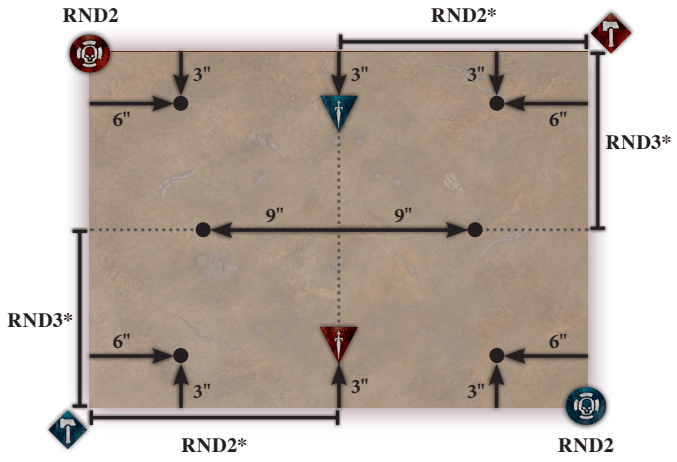
It’s a simple battleplan with a fun deployment map with half of the map perimeter as deployment area (interesting aspect shared with the next mission on the list). I was (naively) hoping that the fact that fast fighters from Shield can reach all objectives in first round will swing the “meta” a bit into “fast horde” archetype, but as slower hordes have both more numbers, better combat capabilities and most importantly – can keep up thanks to movement abilities, “fast hordes” never happened. In the beginning I was expecting the bonus points to be a gimmick that never happens, but I witnessed it few times and it is a very “light” addition, so I started to like. I think it serves a very important balancing role as with Strong-Arm the Competition or an Early Grave you get a reward way better than 1 VP for committing to single area of the map. Thanks to 6 bonus points from all objectives Sidequest over-commitment can be punished.
This battleplan is also my favorite example of how the Sidequests change your strategy for the game. With Run the Interference in play (assume I’m playing blue in this example) I always was stalling with my first round activations (a lot of wait actions that seams unnecessary) and trying my best to position in a way that indicates that I intend to grab both of my closest objectives (few fighters as far right as possible), but in fact I was only trying to get the bottom-left objective and wait actions were there to match in case my opponent will go to bottom right objective. From my experience most opponents (until they see this “trick”) will instinctively grab both top objectives. This approach will grant your opponent one point lead, but next round the top-left objective is impossible to defend against your whole Hammer and as much from Dagger as necessary. Meanwhile all of your Shield is on defensive duty in bottom left. This approach have helped me get 6-4 lead in many games. I also tweaked my list to be able to “counter” my opponent duplicating this strategy – added Dire Wolf to my Shield (in OBR and SBGL, my main Rumble Pack factions). In case my opponent will also leave one of “his” objectives unclaimed to deny 3 VP from Run the Interrference, I would try to “punish” it with my last activation of Dire Wolf that would take advantage of empty objective, which usually ended with 4-3 lead after second round. This was a great plan as if there is no terrain on the path from your deployment point to top left objective the minimal distance you have to traverse to reach this objective is 7,92″, so you first use a wait action on your Dire Wolf, make sure to spend all your ability dice before (so your opponent know that there is no option for bonus move for Dire Wolf). As you can see this Sidequest added completely new strategy to the game (not claiming “free” objectives isn’t something that most players consider), I really like this battleplan.
POWER STRUGGLE
4 objectives battleplan scored every round, with every objective granting the VPs equal to the current round number.

The scaling VP for objectives is a great idea that in theory makes hordes vulnerable to more killy warbands that can fight their way out of numbers disadvantage as during last round 1 objective is as valuable as all 4 objectives in first round, but the problematic hordes were dominating because no list could kill them fast enough. The other thing is that while from the first glance the distance to objectives seams big (which is great, as 3″ move fighters dominate the opposition too hard), in fact there is only 7″ of distance to middle objectives. There is no point in spending too much time on Sidequests as quickly scaling VPs for objectives make them barely a “tiebreaker” as starting with 2nd round there already are 8 VPs to fight over only from primary scoring. Overall it’s a fun mission that is a very bad fit for this battlepack and sadly achieved the opposite to intended (I can only assume what was the intention) goal of making 3″ move hordes even stronger.
SUPREMACY
Every player scores 2 VP for meeting each of the following 3 conditions: you control 2 objectives, you control 3 objectives, you control more objectives than your opponent.
I think this is a battleplan that people have the most mixed feelings about. From one hand a lot of people believe that this is the most “horde friendly” mission as lists that are the most extreme from number of fighters perspective can dedicate fighters to 4 closest objectives and still have someone left that can for example move to the middle to fight for Strong-Arm the Competition, which can lead to devastating 9-4 or 9-2 start just from the first round (I believe the most oppressive form of this would be SBGL list with 2 Dire Wolfs and sir Jedran which can lead to SBGL player having 1 fighter on each objective and 30 wounds in the center. If this sounds oddly specific – it’s because this is the list I run to a great success). On the other hand the battleplan is popular enough to be featured in 2023 Nova tournament pack (at least on the current version of the pack in the moment of writing it, tournament has not yet happened). If you are confused by my example with fighters on all 6 objectives, its because I forgot to mention, that this is the only mission where small cavalry base or 60mm round base can contest 2 objectives at the same time (obviously assuming there is no terrain between objectives).
This battleplan require controlling 3 objectives and at the same time fighting for Sidequests or some additional objectives to win, which is almost impossible to non-horde warbands due to simply not having enough fighters. Run Interference and Strong-Arm the Competition should help more elite warbands in theory, but in reality if horde player is basically guaranteed to get 6VP per round from primary scoring for the Sidequest points to make the difference you have to either win Strong-Arm the Competition every round (which is almost impossible as opponent with significant activation advantage have huge flexibility on how to position his fighters to deny some VPs from primary scoring or win the wounds count in the center. Also with less than 4 fighters in Dagger elite list can score maximum of 5 points) or conquer enemy objective every round while also not losing any objectives which not only sounds almost impossible. Other Sidequests grant way less VP so the situation with them is even more grim for elite warband player. The thing that isn’t needed is the ability to chose in which turn you want to deploy your Hammer which basically only comes to play if the leader would be setup this way in an Early Grave Sidequest and scary fighter already in position.
TIDES OF BATTLE
Standard 6 objectives battleplan scored every round (1VP/objective) with the player without initiative choosing one to be worth double the points.
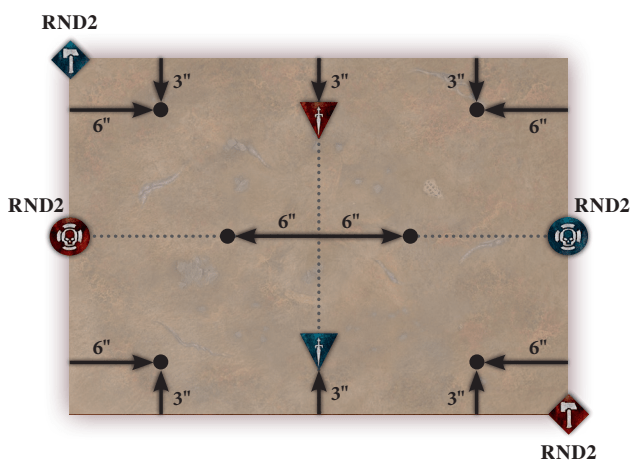
Unlike previous missions this one has initiative related advantage which I hate. Fortunately there are no other glaring “issues” (the initiative thing isn’t even half as bad as in some of the Core Book scenarios, but I still don’t like the idea of granting players Victory Points based on Initiative) with this battleplan. With 1 VP per objective Sidequests actually do their job and provide meaningful scoring opportunity. If we describe the main idea behind Rumble Pack as “objective heavy with Sidequests bridging the gap for more elite warbands” then this battleplan is a great success. What I like is that both this mission and the previous one have Dagger entering the battle in the same place with opponent deployment group deploying in the near corner in 2nd turn. It gives you the chance to prepare the strategy that would block your opponent fighters there. While it can be frustrating (especially if one of the cornered fighters is warband leader in an Early Grave Sidequest) it provides access to interesting strategy and may influence initiative priority in 2nd round, as on one hand you may want to go second to choose the 2VP objective, but on the other hand going first may mean setting up/escaping the corner trap. Unlike previous mission you can fight for Strong-Arm points at the same time as you contest middle objectives which creates 2 very important points on the map with this Sidequest, you also can’t stand on 2 objectives at once.
TO implementation
Despite the fact that this battlepack contains instructions for all aspects of tournament, most TOs (Tournament Organisers, check Warcry Dictionary for more abbreviations) modify the rules and not run the pack “as written”, even Games Workshop does this during their “official” events. Most often changed rule is not drawing the missions randomly and chosing the mission+sidequest pairs ahead of time, randomly drawing missions and sidequests but from limited pool, using Major/Minor Victories and changing the time dedicated for the round. I am ignoring the “hobby related” parts of the pack and focusing only on gameplay related topics here (there are rules for that too). Despite the fact that Rumble Pack is run differently in different places I will try to summarize it to prepare a holistic perspective.

Battlepack Strengths
I must start with the quality of battleplans. Outside of Spoils of War the battleplans themselves range from ‘OK’ to great, with Loot and Pillage being the favorite treasure mission for many players and I certainly share this believe (not allowing players to drop the treasure is a fantastic rule here). Both 4 objective battleplans are also great and I like how 6 objective missions play in horde vs horde matchup too.
There are also some great mission+sidequest combinations that were great to play and created situations where unusual strategies were born. I already mentioned the “leave free objective” strategy. but other interesting combination is Loot and Pillage with Predator and Pray where with denser terrain against less mobile opposition you can try bodyblock access to the treasures on your side of the map and not pick them up to deny “automatic” Predator and Prey scoring. Loot and Pillage with Run the Interference becomes a “hunter mission” that is quite fun to play too.
The change from 4th round scoring to scoring every round and having many important areas on the map to fight over rather than single one as in Cursed Relic or Hidden Vault lead to more complex situations on the table and way more tactical challenges which is great. If the battlepack would be less skewed towards hordes (by for example including more kill/treasure missions) it would be (in my humble opinion) near perfect.
Battlepack Weaknesses
I will starting with something that I don’t think most people will expect – excitement. When heavily wounded fighter jump from the tree to deliver a killing blow on 1HP opponent in Reaper, rolls 1 for falling damage and dies because of it – it can became a funny story and certainly a nice situation that most likely will be shared with other players around. It’s a tense and exciting moment with high stakes rolls with parts that are cinematic, tragic and comedic at the same time. The same situation when the fighter is going for 4VP objective in 4th round of Power Struggle and dies makes a story that is way worse (but probably have the same stakes tournament wise). Warcry is a game and ultimately fun factor is one of the biggest factors and there is a bit less fun in playing almost only objective missions. When I try to remember the most memorable moments from my past games they almost never happen around “objective play”.
The biggest and most obvious problem with the pack is the perfect combination of elements that each favor horde warbands and when combined give non horde warbands very low chance of success against way more numerous opposition. Certain archetype being favored isn’t actually a big problem as it will almost always be the case, the problem is the extent to which hordes have advantage which in Rumble Pack is massive. Even handpicked pairs of battlepack+sidequest will still favor numbers.
The other problem with the pack is that some combinations of battleplan+sidequest are weak and in some situations the Sidequest scoring is either not impactful enough to matter (for example Conquering the Land in Power Struggle) or dominates the experience (for example Strong-Arm the Competition in Loot and Pillage). It happens because both battleplans and sidequests vastly differ in the number of VPs they provide.
As always, thanks for sticking to the end. Next Post in the series will be about theSaltySea’s Tidal Pack (The link will appear here after its published -> )
 Overthinking Warcry
2 responses to “Overthinking Battlepacks part II: Rumble Pack”
[…] If you are interested in previous parts, then here are the links to posts about Core Book, Rumble Pack and Tidal Pack. Today is the day that I release my own project so instead of usual analysis you […]
LikeLike
[…] but I would also consider the Seize and Control + Run Interference trap I described in THIS article as other […]
LikeLike