Hi, welcome to the last part in Overthinking Battlepacks series (there might be more in a future if we get some new big battlepacks). If you are interested in previous parts, then here are the links to posts about Core Book, Rumble Pack and Tidal Pack. Today is the day that I release my own project so instead of usual analysis you will get the thought process behind certain decisions and ideas that led to creation of Mark of Chaos battlepack. If you are not interested in the creation process and ideas behind it, the battlepack is available HERE and in the Battlepacks tab on top of the page.
Goals and Overall Structure
First question that demands to be answered is obvious – why creating new battlepack when others exist? The answer to this question is simple – because analyzing battlepacks over the course of this series was fun (Overthinking stuff is kinda “my thing” if you haven’t noticed yet). Additionally, there was a Discord discussion about creation of global tournament standard and I think none of the most popular battlepacks perfectly fills all the criteria that I would expect from “tournament standard battlepack”. Outside of trying to fill this difficult role what are the other goals for the battlepack itself? To find an answer let’s try to imagine perfect battlepack (Obviously I will fail at creating a perfect battlepack, but it’s a good place to start with looking for point’s of view from which we will judge the whole project). I think the list below will summarize it well:
- Fun to Play
- Replayable
- All warband archetypes should be viable
- Should work in different tournament structures
- Includes incentives for less popular fighter/ability choices
- Difficult/Impossible to “solve”
Lets try to figure out how to reach this goals.
Fun to Play – What is fun is different for every player, but for some reason there is some consensus around definition of what is “unfun”, so let’s try to narrow that down and avoid at any cost. The term “getting Warcried” (I will be using a lot of terms that can be tricky for anyone new to the hobby – I got you covered. Warcry dictionary is available HERE) was created in previous edition and describes a situation that after randomly drawing cards from deployment, victory and twist decks the chance of winning for one of the players was extremely low. I think it can be summarized as getting screwed by RNG before the battle starts. To avoid that we should minimize the NPE connected with deployment map to minimum. To achieve that deployment maps have to be constructed (yes I will create them from a scratch) so a player can have a key fighter required for warband to function (like for example Calthia Xandire) available as often as possible. Round 3 deployment is not an option and to minimize situations where your key fighter is not available, I think all deployment maps will have 2 deployment groups starting the game in 1st round (Rumble Pack deployments heavily favor swarms and we also don’t want to favor any archetype too much. Additionally trying to balance problems like Chimera by lowering the average time it spends on a battlefield is punishing all expensive models that aren’t a balance problem). Other form of NPE is preparing a skewed list based on expected results of battleplan draw and getting the worst possible draw (I know the pain of bringing the list that is close to unbeatable in objective missions to an event where all non-objective missions were drawn), whether this behavior is good or not is not the point – it certainly isn’t fun to feel defeated by RNG and not your opponents (in a situation I mentioned my opponents definitely deserved their wins – want to make it clear). To eliminate such situations the balance between mission types should eliminate possibility of “bad draws” and “getting warcried”. I found only one way of achieving that (in a simple and elegant way) and it’s limiting the number of battleplans of each type (kill/treasure/objective) so you can’t ever draw 4 objective missions in a four round tournament and the result of a draw is way more predictable and balanced (which also leads to healthier meta). There are same potential problems with replayability and higher potential for “solving” the pack connected with low number of battleplans, but we will deal with that later. I mentioned the balance between mission types and I think mimicking Core Book setup with 2 objective missions, 2 treasure missions and 2 other/kill missions is a good approach. I’m not experienced or mathematically skilled enough and didn’t run any regression analysis on fighters point costs, but theSaltySea, who I believe to be wiser than me about the game, mentioned that cost algorithm was prepared with Core Book missions in mind, so keeping similar formula seem like a safe bet. 2/2/2 Split also leads to quite satisfying random draws where the most “skewed” results for 3 and 4 round tournaments (which are basically almost all tournaments at the moment) are 2/1/0 and 2/2/0. With Tidal Pack or Rumble Pack you can and up with 3/0/0 and 4/0/0 which isn’t great and sometimes leads to constructing additional rules around mission draws which is not something you want in a candidate for a universal standard.
Replayable – There are different ways of making 6 mission battlepack replayable. One of the ways would be to randomize the number of objective/treasures and let players decide on its location, but we want as even playing field as possible and balanced deployment groups. Some setups may lead to NPE (elite vs horde in a game with 6 objectives or playing as horde against You messin’ in one objective mission) and we will try to avoid it. Another route is copying Rumble Pack idea and adding a set of secondary scoring, but it seriously limits the VP ranges we can use to not mess up a balance between the importance of both sources of Victory Points (Rumble Pack failed with this, secondary scoring can’t work in a 4 objective missions where one scores 1VP/objective and the other scores up to 4VP/objective). This led to few great primary+secondary combinations and some that doesn’t work in Rumble Pack. Also having very limited number of kill/treasure mission deployment maps make it easier to “solve” the pack and makes is difficult to balance the impact of deployment groups. Let’s draw from my local tournament scene here – Our creative TO makes our tournament packs with Victory conditions disconnected from deployment maps which on one hand increases the number of final mission combinations by multiplying the number of maps (let’s go with 6 so there is nice symmetry with Victory Conditions) by the number of Victory conditions. This way we can also create balanced deployments for different numbers of objectives and treasures changing the 2 objective and 2 treasure missions into 12 combinations of each. It’s a difficult task as deployment maps need to also work in kill missions, but I believe this is the way to go. Implementing this solution gives us 36 combinations which is the same as Rumble Pack, which isn’t bad and certainly makes the pack replayable.

All warband archetypes should be viable – I mentioned in previous paragraph potential risks with running single objective against You messin’ (1 treasure in some setups is also very bad) and another issue with 6 objectives. If we want to keep the battlepack “friendly” for every warband then we should consider which setups can’t ever work for some warbands and try to avoid them. The minimal warband size is 3 fighters and to give them a fair chance of competing against more numerous opponents I think the maximum number of treasures and objectives should be 5, so they can aim for 3-2 result. In case of objectives, it may be extremely difficult, but running 3 fighter warband is already expected to have big challenges in objective missions. There are also plenty problems with single or double objective/treasure setups, where winning initiative grants powerful advantage where you can grab all treasures (even 2 treasures with Inspiring Presence) before your opponent first activation. Because of this let’s set minimal number of treasures to 3. To keep everything symmetrical and balanced the number of objectives/treasures will be split into 3/3/4/4/5/5. In previous paragraph we discussed how to increase replayability and initial 12 objective/treasure missions looks way less diverse when described as 2 objective/treasure missions with 3,4 or 5 objectives/treasures. It also seems way easier to “solve” and to have a high risk of heavily favoring some factions/archetypes. All of this risks can be reversed into advantages with adding additional layer on top of our design – Twists. Twists don’t have the problem that Secondary scoring has, as they don’t need to be parametrized based on other element and can work way more independently influencing the game with more freedom. The end result of adding twists will make the game more difficult to “solve” (more changing variables in game), more replayable (36 combinations grow to 216) and can help less “viable” archetypes, fighters and abilities by increasing their value or by decreasing the power of the strongest archetypes, fighters and abilities. Currently the most underplayed models are “mid-range fighters” because they are worse than cheaper fighters (chaff) in objective missions and are worse than more expensive fighters (dragons/titans and monsters) in situations where killing\surviving is required (kill missions and often treasure missions). This makes them a worse choice in almost every situation and I think there are 2 ways of making them more attractive. First thing that can help them is limiting the scoring opportunity of the biggest fighter in warband to once per battle in a kill mission. This means that in “damage dealing competition” a powerful Titan can almost “guarantee” to outdamage the opposition in a single round, but 3 other fighters will be required to “perform” in other rounds. Titans like Gutlord and Chimera dominate the current meta and this approach will help to keep the biggest fighters more in line and will give incentive to spread “damage budget” a bit and to replace the biggest guys with bigger number of “5th biggest guys”. This should help a bit the more expensive part of fighters in “midrange hell” and the cheaper part should receive quite similar help. Some twists should make the cheapest chaff a bit too weak to survive. This should give the incentive to look for the 2nd/3rd cheapest fighters to be able to fill the chaff role (in this case it will be “chaff+”) and survive long enough for investment to pay off. I would like to avoid negative incentives as much as possible, but I don’t know any other solution that would create such environment, so some of the twists should do AOE damage that will naturally affect cheaper (more numerous) fighters more than their more expensive friends. There should be a way of interacting with this “damaging environment” to avoid it at some opportunity cost or to make the situation worse for your opponent (both should preferably involve some less popular and viable fighters/abilities). This will also help to keep chaff swarms that dominate the meta more in line and increase the value of AoE damage abilities as there will be more groups of wounded chaff in games.

Should work in different tournament structures – 6 Deployment Maps with 6 Victory Conditions and 6 Twists can work great in both randomly drawn and handpicked tournament packs. I already mentioned that with balanced Victory Conditions there should be no “all objective” situations and the existence of 3 battleplan layers make it possible to prepare a “semi random” tournament pack with some aspects predefined and some randomized during the tournament, like for example in 3 round tournament choosing one of each type of Victory Conditions and adding predefined twist to them, but having the deployment map random, or having only the twist random (or any other combination). To make running tournament smoother some additional instructions for less battlefield related topics should be included in battlepack, like for example tiebreaker method. Scoring should increase score granularity (unlike Rumble Pack with flat Win/Lose/Draw result) so Minor/Major Victories are in. I believe difference between Minor and Major win should be related with the goal of battleplan, so 10-0 Objective game should always be a Major Victory and 12-13 result is not a Major Lose in my book. Because of this Major and Minor Wins will be included in Victory Condition scoring description and will accurately reflect the scoring situation in game. As “current” Minor/Major decider is and incentive for “violence” to not decrease how “bloody” the games are some other incentives for fighting must be added. I think the tournament rules should make the game easy to follow so beginners or people who doesn’t know the game can understand the situation as this will serve the game popularity in long term and if someone wants to think about tournament standard then this should be an aspect to consider. Mostly because of this I’m not a fan of “hidden information” (required for Core Book tournament Quests), secondary scoring (the goal of the game should be intuitively understood by observers) or Major/Minor Victories decided not based on the main goal of the mission. I will also include the FAQ at the end and try to avoid some of the GW incorrect wording to make TO life easier. At the end we can’t forget that for some players narrative play is a big part of the game and to make the battlepack more attractive I will try to add a bit of flavor to ground the battles more in Warhammer Universe. Gameplay related aspects will be decided strictly from competitive point of view, but short lore snippets that always exist on GW projects should also be there.
Includes incentives for less popular fighter/ability choices – I already mentioned 2 ways to help midrange fighters. The other kind of fighters that is in a very bad spot in the meta are Elf-like fighters. They are hurt by a combination of 3 problems. First is that the movement is the most expensive characteristic and there is almost no opportunity cos of running slow fighters. To help in this front I plan to increase the distance to treasures/objectives and implement twist that will give players a weapon that is more efficient against slow fighters. This should also help to decrease the dominance that 3” move fighters have in the meta. The Second problem is almost the opposite of the first one – Elf-like fighters have Very low Toughness and Toughness is extremely cheap in this edition, which means that slightly more expensive fighters are a lot more durable (and efficient) than Elves with the same number of wounds. Third problem is that Elf-like fighters usually require “crit fishing” as their main source of damage which makes them very susceptible to Counter. Low Strength and low Toughness is not something battlepack can fix but including a twist playing to their strength seems like a good idea. Adding bonus damage to Critical Hits against fighters when target’s Toughness is higher than attacker Strength should help low Strength fighters like Elves at the cost of high Toughness fighters (and durable chaff swarms seem too strong in the meta, so we hit 2 birds with one stone here). Mentioned twist helps all hordes, so we need to make sure they stay in line. Other overlooked fighters (outside of KO) are cheaper ranged units that are overcosted in most cases. To make them a bit more viable return to 2 topics I already mentioned – AoE damage twist we can interact with and Kill mission that require to use 4 different fighters to compete every round. As I plan to increase distance to opponent to make life a bit more difficult for 3” move fighters then doing anything damage-wise in first round of the game would in most cases require to either have a very fast fighter or a ranged fighter and this is a place where unexpected Goblin Shoota can “outdamage” a slow opponent that won’t be able to attack anything in first round of the game (I actually won one game against Iron Golems this way and I was very happy for my little goblin), so the first incentive for any ranged options is already covered, but as it will work better with more popular artillery fighters let’s not stop here. Let’s go back to the AoE environment damage I keep mentioning. Some battleplans include additional “battle royal” like rule of hurting fighters close to battlefield edge. I like the idea and to make it less oppressive and boost the power of archers and ranged damage in general (especially AoE), lets modify it to only affect wounded fighters. This way pinging a healthy fighter hiding far from all the action will not only result in increased damage, but also limit the area where he can move without being hurt in future turns (which further limits the power of 3” move fighters as they have very limited movement range already). There are interesting consequences in deciding to use this type of the quest. First of all, it strongly influence the design of deployment maps, as for such Twist to have a desired impact (Twists that don’t influence the game enough are unnecessary rules, but Twists that hurt your warband too much feel bad) It will require to move objectives/treasures of some maps to the very edges of the map, so important map areas are partially covered by the “damage zone”. Another interesting consequence is that this kind of Twist will make healing abilities (especially AoE) a bit better and heal abilities (outside of Sylvaneth) aren’t popular, so we boost another unpopular option a bit too.

Difficult/Impossible to “solve” – The number of difficult permutations that can be created with the battlepack means that one tournament pack can have a vastly different “Viability matrix” than another one. Especially with battlegroup impact and role. With factions there will surely be winners and losers, with some factions being especially good/bad only in certain combinations and other more in general. I don’t expect single list being clearly the best, but I fear that from the group of the most powerful factions KO were hurt the least, which connected with targeted “hate” at their direct competitors may lead to them being the strongest faction. It’s very difficult to predict the shape of a meta in theory, but I hope that 4/6 Victory Conditions being non-objective based and some of anti 3” move and anti horde elements will not only keep Fight for Profit under control, but also will give this objective dominating faction a tough nut to crack.
What to avoid
In introduction I mentioned that I hope to avoid some of the problems that other battlepacks didn’t. Big part of the topic was already covered in a part about elimination battleplans with too few/too many objectives/treasures. It might be a very small detail, but if a battlepack is to be used as tournament standard then it should cover aspects like scoring granularity and tiebreakers, to standardize final scoring across different tournaments. This will give players playing at different events more ground to compare their score. In previous parts of the series, I complained a lot about kill missions and constructing them in a way that mitigates (even if only partially) some of the problems they tend to have is very important. I already mentioned that splitting the scoring responsibility to few fighters is a way of dealing with problem of “the team with the biggest guy usually wins”. A lot of missions from the battlepacks I covered in earlier posts of the series gave players some advantages (sometimes small and sometimes colossal) based on dice roll (most often initiative). I think tournament should provide as level playing field as possible and that’s why I believe such battleplans should be avoided if possible. The most important problem of Rumble Pack is that it heavily favors single archetype, but I hope that my fight with that on many fronts (deployment maps, victory conditions and twists) will result in a healthier balance. Core Book had “gimmick” rules (Hidden Vault) that in great majority of cases had the same result and “empty” rules like that should be avoided. I don’t like bashing other people work so I will keep this part very short. Last item on the “what to avoid” list is – bad battleplans. Some battleplans lead to boring or noninteractive games and others have very bad rules, like Spoils of War. To not make similar mistakes I will mostly stick to proven concepts and draw from the best parts of other battlepacks (like great and universally loved Loot and Pillage).
Actual Battlepack
I would want to start from deployment maps, but as they must be considered in a context of both Victory Conditions and Twists I think the better idea is to start with Victory Conditions. I already “spoiled” a lot, but here are the Victory Conditions:
The number and location of objectives is
determined by deployment map. At the end of
each battle round, players score 1 victory point for
each objective they control.The battle ends after 4 battle rounds. When the
battle ends, the player with the most victory points
wins the battle. If the difference in Victory Points is
bigger than 2 it’s a major victory, otherwise it’s a
minor victory.
The number and location of objectives is
determined by deployment map. At the end of
each battle round, players score a number of
victory points equal to the number of the current
battle round for each objective they control.
The battle ends after 4 battle rounds. When the
battle ends, the player with the most victory points
wins the battle. If the difference in Victory Points is
bigger than the number of objectives on
deployment map it’s a major victory, otherwise it’s
a minor victory.
A classic objective mission with no extra rules and a variant with scaling VP. Scaling VP is more elite friendly so together with other anti horde mechanisms I hope to have elite/horde balance under control. In case it isn’t as balanced as I expect it to be – Twists could be tweaked to adjust it. The biggest change to other battleplans is the Major/Minor Victory condition included in the mission itself. Let’s take a look at Treasure missions:
The number and location of objectives is
determined by deployment map. A fighter within
1″ of an objective can LOOT that objective as an
action. If they do, that fighter is now carrying
treasure and cannot use an action to drop that
treasure. If a fighter that cannot carry treasure
LOOTS an objective, that fighter immediately drops
that treasure as a bonus action. After a LOOT
action is made within 1″ of an objective, remove
that objective from the battlefield.
The battle ends after 4 battle rounds. When the
battle ends, the player who has the most fighters
carrying treasures wins. If the winner has 1
treasure more it’s a minor victory, otherwise it’s a
major victory.
The number and location of treasures is
determined by deployment map. At the end of
each battle round, players score a number of
victory points equal to the number of their fighters
carrying treasures. Additionally, players score 1
victory point every time enemy fighter drops the
treasure.
The battle ends after 4 battle rounds. When the
battle ends, the player with the most victory points
wins the battle. If the difference in Victory Points is
bigger than the number of treasures it’s a major
victory, otherwise it’s a minor victory.
Loot and Pillage is by many considered to be a new golden standard for treasure missions so I could not skip it. I went with 1 treasure/objective as with random deployment map there is no other way and I kept the “no drop rule” mostly to not cause any confusion as both Rumble Pack and Tidal Pack used it. Second mission has kill mission elements mixed in and penalizes passing the treasure to other fighters. I wanted to add more decisions to treasure gameplay as currently there is no reason to not pick up treasure as soon as it hits the ground, but when your opponent can kill multiple chaff units in a turn then picking the treasure up just to die, donate 1 VP to opponent and go back to previous situation one VP and one fighter short may not be the best idea. I hope people will like my small “innovation”. Let’s move to last mission type left – kill missions:
At the start of each battle round (before initiative phase), each player, starting with the defender, picks 1 enemy fighter to be a HUNTED
FIGHTER. At the end of each battle round, players score 1 victory point for each enemy HUNTED FIGHTER that was taken down in that battle round. Players score 1 additional victory point for each of the following that is true about taken down HUNTED FIGHTER:– it had a MONSTER or HERO runemark
-it had the highest (or was tied for highest) wounds characteristic of all the enemy fighters.
The battle ends after 4 battle rounds. When the battle ends, the player with the most victory points wins the battle. If the difference in Victory Points is bigger than 2 it’s a major victory, otherwise it’s a minor victory.
At the start of each combat phase, starting with the player that has initiative, each player picks 1 fighter in their warband that is on the battlefield that was not picked in any of the previous rounds. That fighter is referred to as UNHINGED FIGHTER until the end of that battle round. Every player must keep a total of the damage points allocated to enemy fighters by attack actions made by their UNHINGED FIGHTER in that battle round. The player with the highest total at the end of that battle round scores 1 victory point or in case the damage difference is bigger than 5 – 2 victory points.
The battle ends after 4 battle rounds. When the battle ends, the player with the most victory points wins the battle. If the winner has 1 victory point more it’s a minor victory, otherwise it’s a major victory.
This two missions shouldn’t surprise anyone who played with Victory Cards from big boxes released this edition, as they are a modified version of two of them. I like both of this missions as all the attention is focused around eight fighters that are picked by the players (eight being the key figure in kill missions is also very lore appropriate). In first mission your opponent will pick 4 of your fighters as targets and standard team composition consisting of the cheapest chaff and few big guys may be very strong at killing their intended targets but at the same time not the best at keeping their chaff alive against similar team. On one hand it provides incentive to consider using a bit more durable chaff and trying to prevent your opponent from achieving 4 scoring kills and on the other hand to achieve a major victory you should not only keep your chaff alive but also consider attacking more ambitious targets to get extra points. Second mission presents reversed situation where instead of having 8 “targets” with no focus on who is actually doing the damage it has 8 fighters (different pair every round) who’s damage is the only important factor and their target aren’t important from scoring perspective. With single fighter scoring VPs in only one round there is a chance we will see more balanced damage spread within warbands. I’m a bit afraid of Brewgit becoming even more important than he is currently, but maybe destruction players will decide to replace Gutlords and Tyrants with few cheaper fighters which will lower the value of Brewgit slightly.

Let’s move to the most controversial part of this battlepack – Twists:
Grandfather Gifts
Objects blessed by Plague God are a source of unimaginable diseases and a horrifying catalyst of decay.
At the end of each round, before control of objectives is determined allocate one damage point to each fighter within 3″ of any objective or treasure.
Originally it dealt damage equal to number of current battleround minus 1, instead of flat single point of damage, but I was persuaded that it’s too much and a lot of players would hate it. As there are planty mechanisms that make running a swarm more challenging I think going to single point of damage was a right decision, but I really enjoyed playing the original form, so I think I’m not 100% convinced yet. I believe increasing the damage here will be the first step in case hordes would end up too strong (which I don’t expect). Idea behind this twist is very similar to one I mentioned in part about treasure missions. Currently there are very few situations (basically only Run Interference in Rumble Pack and Might Makes Right in Tidal Pack) when fighter would not always prefer to stand on an objective. With single point of damage this aspect is a lot weaker, but I still think it creates an interesting environment where the cheapest chaff may became slightly weaker in comparison with some more durable options. Elite lists also receive a slight help against hordes without changing the scoring, which is an underused way of balancing in my opinion.
Torrent of Flames
This place used to be an armory of chaos worshiping dwarves. Many of their weapons are still here to be found
All fighters get access to Horned Grenade ability
[Double] Horned Grenade: Pick a visible enemy fighter within 6″ of this fighter and roll a number of dice equal to the value of this ability. For each roll exceeding the Movement characteristic of that fighter, allocate 2 damage points to them.
It’s simply a way of decreasing the power of 3″ move fighters as they are the best target for the ability. Originally the damage was much higher and also again, I was persuaded to decrease the impact of Twists. This twist is not negatively affecting elf-like profiles when hurting a bit their slower competition which is just icing on the cake.
Changer of Ways
Tinkering with Fate often twists the area around in incomprehensible ways.
After finishing move action within 3″ of battlefield corner you can pick up your fighter and set it up wholly within 3″ of opposing battlefield corner.
I’m particularly excited for this Twist as I can’t predict how people will react to it. I heard it being called “a gamechanger”. The basic idea behind the Twists is to impact the game to the level when the same deployment map with the same Victory Condition feels very different with every Twist and I think this is a perfect tool for that. I expected this to be element that will be second in people reception polarization. I hope to see some comments about it on Discord, Reddit or Facebook.
Vermintide
Dozens of rats seem to be watching you from every shadow. You feel that if you are to survive this fight, the next one will follow.
At the end of each round, before control of objectives is determined, allocate 2 damage to each wounded fighter within 3″ of battlefield edge.
This Twist together with the one above is the reason I wanted to discuss Twists before Deployment maps, as all deployment maps need to be considered with both of them in mind. This Twist is rewarding ability to do ranged, especially AoE, damage that outside of “Engulfing Flames” isn’t popular. It also makes healing abilities way stronger and outside of Sylvaneth there isn’t much healing in the game. The impact of this Twist (the same is truth for previous one) is heavily dependent on deployment map that’s why I believe that initial opinion and opinion after testing it in practice can be very different. I also think the lore around it fits very well.
Blood for the Blood God
Khorne gaze fills the mind with insatiable murderlust and clouds all other thoughts.
Only fighters that dealt damage to enemy fighters can pick up treasures or contest objectives.
I expect this to be the most controversial part of the whole battlepack. It favors shooting a lot, but I think having a reason to pick Tyrant over Gutlord or Lord-Imperatant instead of Calthia Xandire might be a good thing. One of the problems is that Arkanaut spam seem unbeatable in objective missions with this Twist, but as it is only 5% of all possible combinations, I hope it will not make everyone hate this Twist. If people will hate it, then I will change it (I expect to prepare second iteration if there will be a lot of issues people have with it and this is the place I expect the most issues)
Sadistic Excellence
Inflicting pain on those most resilient is rumored to be a great way to draw Dark Prince attention.
Add 1 to the damage points allocated by each critical hit from attack actions against opponents with Toughness higher than attacker Strength
This is another way of helping Elf-like profiles and a way of supporting fighters that usually are on receiving end of Counter reaction. I don’t agree with the notion that Counter should be nerfed, but I agree that fighter’s that often abuse it are too strong and this is the way of helping with “critfishing” necessary to deal with such threats.
After covering all the rules text let’s move to geometry of deployment maps:

All the action is expected to happen on one diagonal, which means that Changer of Ways will be twice less impactful than in other maps. Shield deployment can also prevent the teleport of units with bigger bases. Second round deployment position is there to eliminate “safe area” where you can go after picking up treasure to minimum.

I believe that “Plant the flag” from Tidal Pack was designed with very similar goals in mind, as both are very close and were created independently (half of this battlepack was created before Tidal Pack was first published, yes I know I’m very slow with my projects). The basic idea was to try to prepare a deployment map where in treasure/objective setup fighters with move characteristic of 3” start the game behind faster opposition. I know that movement buffing abilities are equally as important here, but it doesn’t lesser the need to increase opportunity cos of running slow fighters. Objectives are very close to the battlefield edge to increase the impact of Vermintide here.

Very classic setup with relatively high distance between objectives/treasures. As both Vermintide and Changer of Ways have limited impact because of objective/treasure and first round deployment point positions I expect it to be the most “traditional experience” out of all deployment maps.

A map that seems very similar to previous one, but it is designed with main goals of this battlepack in mind. All deployment groups (especially Shield) are way more distant from objectives/treasures, objectives/treasures are partially covered by Vermintide damage zone and all deployment groups start in the corner so they need to include Changer of Ways in their plans.

This map is designed to maximize the impact of elements listed with previous map. Most of objectives are inside Vermintide danager zone, there is maximum possible distance between objectives that is extremely affected by Changer of Ways teleport. If you love the Twists in this battlepack that map is for you and if you are a bit more skeptical then map number 3 is there for you.
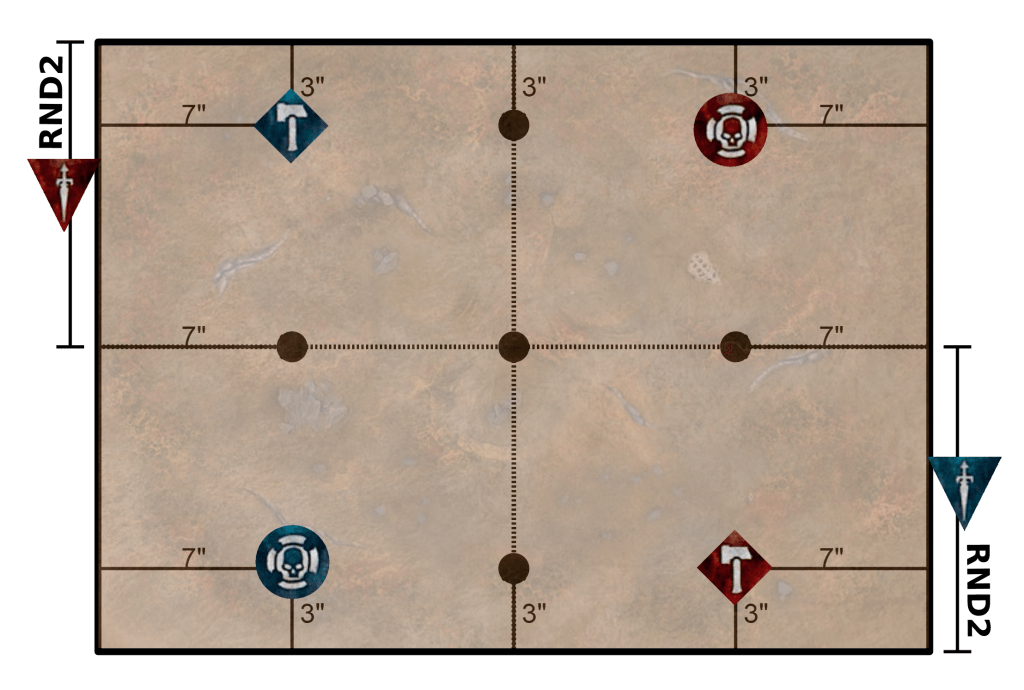
A balanced map where the distance to opponent for deployment groups that start in first round is a bit lower than usually and a bit higher for 2nd round reinforcements. Sadly with 5 objectives/treasures you can’t escape putting one in the middle so in fact it must be a variant of 4 objective/treasure map with extra one in the middle.
Ok, now when you saw all the maps its time for some comparisons and mathammer. The idea was to increase the distance to objectives and let’s see how the numbers look:
| Measurement | Tidal Pack | Rumble Pack | Mark of Chaos |
| Average Distance to Objectives for Dagger when deployed first round | 12,29 | 12,79 | 15,6 |
| Average Distance to Objectives for Dagger when deployed second round | 13 | 13,8 | 13,74 |
| Average Distance to Objectives for Dagger | 12,7 | 13,3 | 14,9 |
| Average Distance to Objectives for Hammer when deployed first round | 12,9 | 7,7 | 14,36 |
| Average Distance to Objectives for Hammer when deployed second round | 13,43 | 15,05 | 10,56 |
| Average Distance to Objectives for Hammer | 13,1 | 13,83 | 13,41 |
| Average Distance to Objectives for Shield when deployed first round | 12,37 | 11,19 | 15,47 |
| Average Distance to Objectives for Shield when deployed second round | 14,92 | 16,82 | 15,92 |
| Average Distance to Objectives for Shield | 13,8 | 14,94 | 15,64 |
| Average Distance to the closest Objective when deployed first round | 6,8 | 6,49 | 9,93 |
| Average Distance to the closest Objective when deployed second round | 6,59 | 6,94 | 6,04 |
| Average Distance to the closest Objective | 6,68 | 6,79 | 8,63 |
| Average Distance to 2nd closest Objective when deployed first round | 9,38 | 8,44 | 11,55 |
| Average Distance to 2nd closest Objective when deployed second round | 11,11 | 11,71 | 11,63 |
| Average Distance to 2nd closest Objective | 10,34 | 10,62 | 11,58 |
| Average Distance to 3rd closest Objective when deployed first round | 13,15 | 11,68 | 17,72 |
| Average Distance to 3rd closest Objective when deployed second round | 13,92 | 15,17 | 16,26 |
| Average Distance to 3rd closest Objective | 13,58 | 14,01 | 17,23 |
| Average Distance to 4th closest Objective when deployed first round | 12,97 | 13,47 | 20,96 |
| Average Distance to 4th closest Objective when deployed second round | 17,25 | 19,51 | 20,37 |
| Average Distance to 4th closest Objective | 15,82 | 17,5 | 20,76 |
| Average Distance to all Objectives when deployed first round | 12,57 | 11,41 | 15,09 |
| Average Distance to all Objectives when deployed second round | 13,81 | 15,33 | 14,01 |
| Average Distance to all Objectives | 13,2 | 14,02 | 14,73 |
The table above clearly shows that in almost all categories the distance to objectives increased. The most important categories in my opinion are distances of deployment groups deployed in first round to first, second and third closest objective as it shows if my intention of getting to objectives harder for 3” move fighters was achieved. For first closest the average distance is 9,93” (over 3” more than both Rumble Pack and Tidal Pack) which means that in most cases KO units won’t be able to both reach closest objective and make ranged attack. What is important is that on average it will be possible for 4” move fighters. Together with single battleplan where 3” move fighters won’t reach the closest objective/treasure in first battle round I believe I have the deployment map “geometry” exactly where I wanted. Let’s move to distance to send closest objective (again, first round deployment only) of 11,55”, which is barely within double move action range of slower fighters. But it also means that any terrain on the way is instantly a big problem. It’s over 2” more than in Tidal Pack and over 3” more than Rumble Pack – which should mean that the amount of objectives reachable by very slow deployment group is very limited, which is exactly what we want (3” move should come with opportunity cost attached). This also increases the impact of terrain and the value of roll that determines deployment color, especially in a game where at least on of the sides is playing slow warband. From both of this statistics I can say that I’m satisfied with how the deployment map math works in relation to objectives. Distance to 3rd closest objective shows exactly the same with 17,72”, which is an increase of over 4 and 6 inches from 2 other battlepacks. Let’s move to deployment group balance:
| Measurement | Dagger | Shield | Hammer |
| Average Distance to the closest Objective when deployed first round | 10,1475 | 10,2425 | 9,4125 |
| Average Distance to the closest Objective when deployed second round | 6,5 | 5,5 | 5,31 |
| Average Distance to the closest Objective | 8,931667 | 8,661667 | 8,045 |
| Average Distance to 2nd closest Objective when deployed first round | 11,395 | 12,8575 | 10,4075 |
| Average Distance to 2nd closest Objective when deployed second round | 12,11 | 11,77 | 9,5 |
| Average Distance to 2nd closest Objective | 11,63333 | 12,495 | 10,105 |
| Average Distance to 3rd closest Objective when deployed first round | 17,725 | 20,3375 | 15,0875 |
| Average Distance to 3rd closest Objective when deployed second round | 15,5 | 15,775 | 16,88 |
| Average Distance to 3rd closest Objective | 16,98333 | 18,81667 | 15,685 |
| Average Distance to all Objectives when deployed first round | 15,60067 | 15,47267 | 14,35722 |
| Average Distance to all Objectives when deployed second round | 13,74222 | 15,91667 | 10,56333 |
| Average Distance to all Objectives | 14,90375 | 15,63917 | 13,40875 |
I was tinkering with deployment groups a lot and this is the best I managed to achieve. I do think deployment groups are fairly balanced both as far as their potential role in battleplan (2nd round flanker, closest to treasures/objectives etc.) and from distance to objectives perspective. Hammer is a bit closer to second closest objective and Shield has a longer path to 3rd closest when deployed in first round, but I don’t expect the differences to be big enough for a situation where single deployment group is way more or less important than the rest, especially in the world where you can’t predict which deployment map will be used with which Victory Condition.
What is missing?
I tried to cover everything people would expect from universal battlepack, but with my limitation of only 6 Deployment Maps/Victory Conditions/Twists I obviously couldn’t cover the needs of all the players and there are some things missing.
First of all, there is no classic “my side, your side” deployment. I believe such deployments heavily favor shooting and lead to frustrating games in some treasure/kill mission setups, so I don’t expect it to be a big issue but such deployments also historically were sometimes a challenge for 3″ move warbands, so I expect some people to expect it for this reason, but I hope I included some other balancing mechanisms that will satisfy the need to punish 3″ move fighters that currently are the most efficient solution to most of the problems you can have in our game.
Other than that, I expect some people to miss old Major/Minor Victory split being decided only on killing your opponent warband members. I hope I included enough incentives to fight (I consider this battlepack to be way „bloodier” than each of the other popular ones) with 2 “pure” kill missions, one treasure mission that rewards you for killing enemy treasure bearer and most of the Twists supporting the brawliest warbands.
One missing thing that some players could want from the Twists pool is “Eerie Silence”, the Twist that has no effect and gives option for a “rules light” game as the first or last one during event. Although there is no “no effect” Twist the same can be achieved by adding Blood for the Blood God or Grandfather Gifts to any of the kill missions as they will have no effect there.
Closing thoughts
Thanks for surviving to the end. I can’t wait to see how people will react to the battlepack as a whole and some of the more unorthodox design choices with few Twists, Separating position and number of objectives from Victory Conditions and Minor/Major Victory decision. I really enjoyed the creative process so James Workshop – if you need some more resources for Warcry team (and the whole community thinks you desperately do) give me a call ;). As I will be a father in six months I might need some arguments for my wife to not get killed for continuing to work on this blog (my posting frequency may not suggest that, but writing in depth articles takes a lot of time and efford), so if anyone thinks that a Overthinking Warcry Patreon is something worth supporting let me know and first of all – enjoy the battlepack and let me know what you love and what you hate most about it. I hope to get some feedback in Discord, Reddit or Facebook. Thanks again.
 Overthinking Warcry
One response to “Overthinking Battlepacks part IV: Creating new battlepack”
[…] Article about battlepack creation – HERE […]
LikeLike