
Link to One-Sheet-Battlepack.
Hi, I apparently can’t stop myself from designing battlepacks and as the previous one received very positive feedback from the community (I believe that it also impacted community in significant way as part of it was played on 3rd biggest Warcry event and many others including Norcry or TTS league and one of the maps was even “reprinted” by GW in their battlepack) its time for a new one.
I learned a lot from people reactions to Mark of Chaos battlepack (Link to last year pack if you are interested) and I think the biggest lesson was that my priorities were wrong. My first priority was to balance the competitive metagame and make it ideal for tournaments. Now I know that if the first priority isn’t fun then the final product may end up good, but won’t probably end up great. Speaking about priorities and lessons learned – watching players mess up rules often, forgetting about twists and not referencing the text ever I end up with the second priority for this pack – it must be simple and easy to reference (no-one is experimenting with battleplan formatting – lets change that). I decided to make sure the whole pack can fit on single sheet of paper and to (mostly) have battleplans with only 2 things going on (when there is primary scoring, secondary scoring, catchup mechanic and some additional rule then maybe the mission is better balanced and more replayable but certainly the complexity starts to hurt fun, especially when you want to use it outside of events).
I mentioned events and my main goal (that I failed miserably) for previous pack was to create a plug and play system for tournaments that could standardize them a bit. Due to refusal to randomize battleplans by TO’s it was mostly used as a collection of battleplans, which isn’t bad but I was (naively) aiming for “more”. Now I still want to propose the pack for matched play events, but I’m way more realistic and simply want it to be treated as replacement for creating battleplans from cards (it has the replayability factor of cards but also is a more balanced set that still allows some preparation) or simply as a battleplan generating tool that people can pick up when they don’t know which mission to play.
Maps
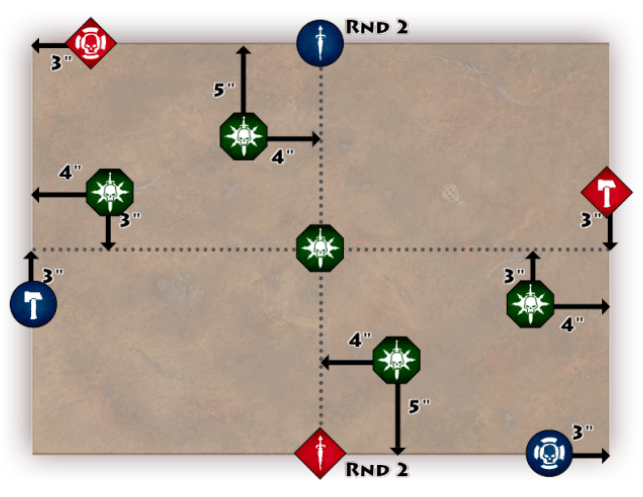
Last year I started to experiment with symmetry designing maps that keep the “point symmetry” against the battlefield center, but have objectives or treasures that are not symmetric against “fold lines” giving them asymmetric feel and both maps following that rule return in this pack (and are the only returning ones). The rest of the maps except for one also keep this rule which adds a bit of uniqueness and character to the pack (it least in my mind).
First two maps are the only “reprints” I already mentioned from last year:

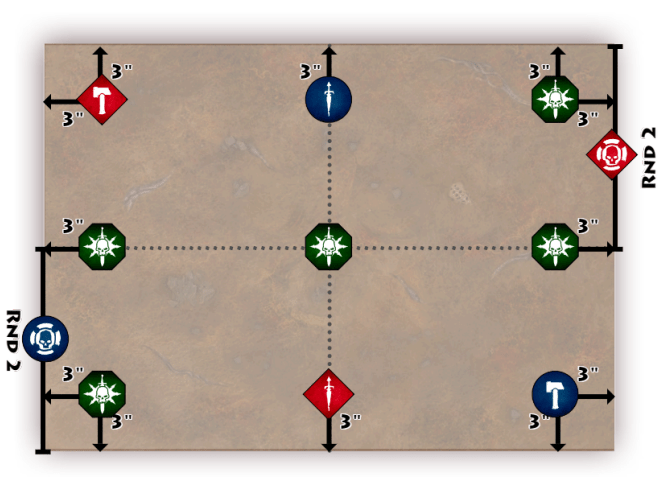
Next two maps are continuation of my experiments with objective/treasure positions:

There is single map with more “classical” approach to symmetry, but with this many objectives/treasures there is way less freedom:
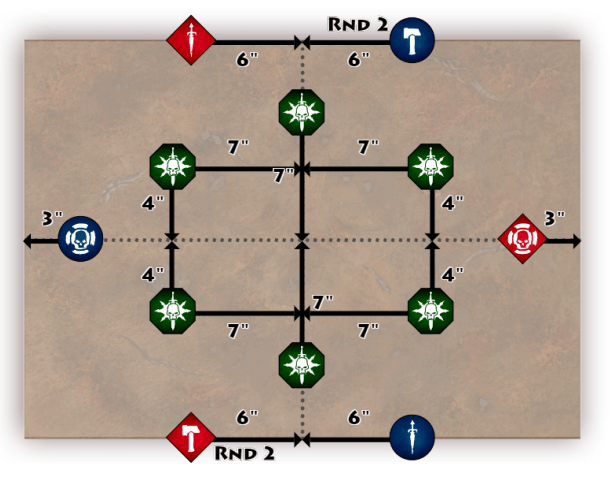
And finally the “big” experiment (not that big really, its a very minor change, but it introduces new approach – maybe its not new and I simply missed it in previous maps, if it is the case – please let me know) – changing the standard point symmetry for deployment groups and moving to “fold line symmetry” only. I still think that streching the Dagger deployment line to the whole battlefield edge looks better, but this version differentiates shield and Hammer a little bit more, which I believe is a good thing.

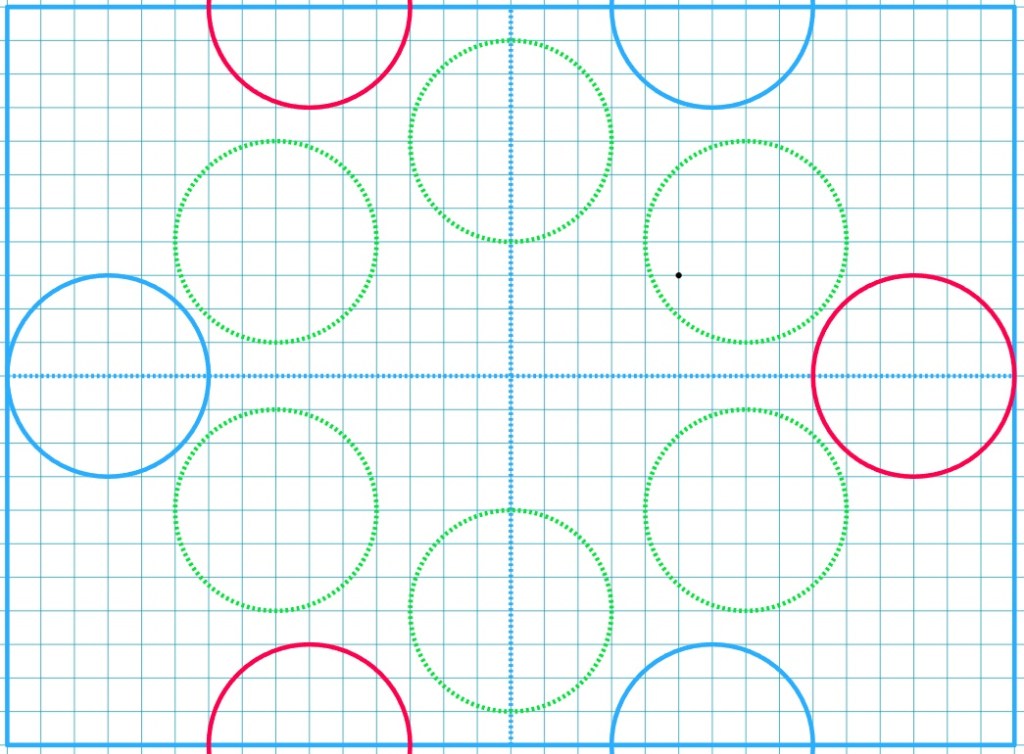
In the end I want to share a little advice with my fellow “overprep psychos”. Analyzing and planning gets way easier when you treat objectives as circles (also some of my maps make way more sense when watched this way), example below:
Victory Conditions
Lets start with short introduction on how to use the pack and what I tried to achieve here. To make it more readable I formatted battleplan descriptions into sections to let people read as little as possible, as from my experience some people have extremally strong allergic reaction to reading and re-reading stuff is often impossible to them. That’s why I highlighted which part of the text is connected with game setup (accidently reading that during the game may exceed daily limit of letters they can handle) and which one is connected with scoring (variants may modify it), which is also quite simple. The square boxes next to a game variants are designed to put a dice there that will help track which turn you currently play, but also which mission variant you play. For absolute beginners/playing with kids you can ignore the variants and play a very basic missions, but in other cases I would suggest to use the variants as they add a lot to a game. Clarity and simplicity very important for me so if something isn’t clear please let me know
Objective missions

First variant is merging the scaling scoring with objective removal from Core Book’s Hidden Vault. As remembering the extra rules is sometimes difficult I suggest to use the removed objectives as a reminder of the bonus points that round (1 removed objective = 1 additional VP per objective, 2 removed objectives = 2 additional VP).
Second variant makes high health fighters more valuable in objective missions. Point algorithm (and blessing cost scaling) makes fighters with high Toughness way more attractive than fighters with a lot of Wounds (when comparing fighters durability) and this variant is sending a bit of love towards the fighters that might be played less often. The more different profiles see play the better in my opinion. I didn’t try to influence the meta much this pack (in comparison with previous pack), but this is a place I tried to intentionally help less popular class of fighters (and poor Nurgle mortals). I know that elite warbands is were it matters the most, but I think it changes the usual power perception on objective missions in a good way (Gorger Mawpath must feel nice here).
Last variant is the idea I’m most proud of as I wanted to merge two great concepts – home objectives you want to fight over (defending objectives is rarely additionally rewarded) and changing where the key areas of the map are over the game (which rewards mobility) and I believe I managed to do that in quite an elegant way. I like that failing to execute “the objective conquest” gives points to the opponent so the “points swing” is actually more influential than a single 1 VP. I also like that it might not be the best idea to get all objectives you can in first round, as then you might lack good conquest targets. Adding opportunity cost to otherwise obvious choices is something I find very interesting and is the direction I would like the game design to go. EDIT: It was pointed out that the wording isn’t clear here – you pick your conquest target for one turn, so every turn you only have one that you picked that turn. I updated the text in PDF, but the picture above keeps original wording.
Treasure missions
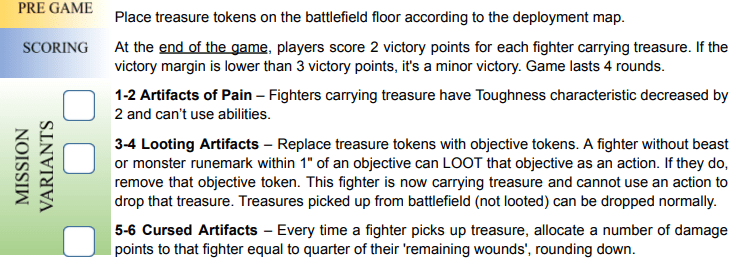
The first mission is here to address the problem of “Great, I lost initiative and now I MUST go into Gutlord’s/[put your worst Nightmare here] attack range to try to steal his treasure”. I know that Sylvaneth and Nighthaunt won’t like it as it shuts downs the teleport option, but you can’t make everyone happy. At least they will suffer for the greater good. As I mentioned – it makes some obvious decisions (who I want to grab treasure with) less obvious, which is good in my book.
Next mission is simply the treasure staple and you can’t miss it in a pack like that. (I don’t love the “can’t drop treasure” rule, but to not create confusion I decided to include it)
Finally the last one is there to make games even more bloody than the first one. First version had half wounds instead of the quarter, but I think that was too much. Enjoy very bloody treasure games, I hope the selected variants will make 3 treasure mission way less of a problem than they usually are.
Kill missions

I believe that the maps I created for the pack, especially the number of potential objectives is making hordes quite favorable and to balance that I decided that every kill in a “kill mission” should be rewarded with VP to make hordes more vulnerable here. The main objective was also to make it “resurrection-proof” so scoring can’t be cheated by death factions. Another important note here that the hordes viewed as most powerful are mostly very slow and my maps do not feature any “my side your side” kind of deployment so every deployment group is in some sort of a danger and the slow hordes will have difficult time running away from opposing threats. I also believe that best missions help you create the story around the game, so I wanted to have certain fighters to be more valuable from both offensive and defensive point of view.
First variant is there to change the usual dynamic of choosing the biggest fighters as Champions and makes it more of a hunt mission. What I like the most about it is that it promotes the midrange warbands that usually aren’t that strong. Listbuilding around wincons where opponent makes decision for you warband is one of my favorite aspects of listbuilding so prep lovers will have a lot to overthink in this one.
Second variant is a modification of one of the twists from previous pack. I really liked how different the game is when you can teleport between opposite corners (it can also give you headache if you focus on that too much) and the tokens you place as the reminders are quite important in my opinion as the worst moments people had when playing this twist were situations when players forgot about the teleport and instead of running away from danger stepped right into it. Give it a shot, players that were skeptical about it often changed their minds.
Last variant (just like the first one) makes midrange warbands quite good. The usual Smalls and Talls list will both have an advantage of big threat for scoring and disadvantage of chaff that will be a very valuable target for the opponent. As I mentioned there is a lot of flanking by r2 deployment groups so slow hordes might be a bit difficult to pilot here, but that is feature and not a bug.
Originally I intended for this text to be way shorter, so I will wrap it up quickly. If you like preselecting your missions or just hate random elements in battlepacks then feel free to preselect your missions, but I would recommend giving the random pairs a chance. For a series of 3 games you can limit the impact of randomness by “rerolling” the type of mission you already played. Yo can do similar thing with deployment maps to make sure that every deployment group starts round 2 once. Once again the link to One-Sheet-Battlepack.
I hope you will have fun playing the pack and that this single sheet of paper will join the rest of your usual Warcry equipment. As always thanks for sticking to the end and if you like my content consider joining my Patreon.
 Overthinking Warcry
One response to “One Sheet Battlepack”
[…] One Sheet Battlepack @ Overthinking Warcry – I love it when fans put out cool, little resources for their favourite games. This compact and concise battlepack from overthinking Warcry is a great format, and one that I could well see the site continuing the future as a great way to put out fun Wacry content. Give it a look; give it a spin! […]
LikeLike